How to Generate Product Descriptions with AI (2026)
Step-by-step guide to AI product description generation at scale — bulk workflows, brand voice, SEO keywords, A/B testing, and 10 tools compared for ecommerce s
- Purpose-built tools like Describely and CopyMonkey generate ecommerce descriptions far faster than general AI writers — pick the right tool for your platform, not the most popular general AI.
- Bulk generation only works with clean, structured input: product name, 3–5 key features, target audience sentence, category, and target keywords per SKU — garbage in, garbage out.
- Brand voice consistency at scale requires tone locking or a style guide upload — Jasper and Copy.ai offer the most robust options for teams with formal guidelines.
- For SEO-first descriptions, Writesonic and Anyword embed keywords and — uniquely with Anyword — predict conversion performance before you publish.
- Thin or near-duplicate AI content can hurt rankings: differentiate at the input level, rotate prompt templates, and always run a human review pass before publishing at scale.
- Hoppy Copy is our affiliate partner; its strength is email marketing sequences for product launches, not on-page product listings.
If you run an ecommerce store with more than a few dozen SKUs, writing product descriptions manually is not scalable. The short answer: tools like Describely and Writesonic can generate SEO-friendly product descriptions in bulk from a structured CSV of your product data, maintaining consistent brand voice and embedding target keywords throughout. This guide covers the full workflow — choosing the right AI tool for your platform, setting up bulk generation, enforcing brand voice at scale, optimizing for search, A/B testing variations, and avoiding the thin-content penalties that quietly cost you rankings and conversions.
What Is AI Product Description Generation, and Why Does It Matter for Ecommerce?
AI product description generation uses large language models to transform raw product data into persuasive, platform-ready copy. You supply the facts — product name, features, target buyer, category, desired tone — and the AI produces benefit-led paragraphs, bullet points, or hybrid formats optimized for both conversion and search.
Why it matters: product pages with thin, generic, or interchangeable descriptions lose rankings to competitors with richer content. At the same time, handwriting descriptions for a catalog of thousands is economically impossible for most sellers. AI closes that gap — but only when used correctly. Raw AI output without structured input and a human review pass produces exactly the kind of thin content that Google's quality systems deprioritize.
The tools covered here are built specifically for ecommerce, not general-purpose AI writing assistants. They understand platform constraints (Amazon character limits, Shopify meta fields), ecommerce conversion patterns, and the specificity that separates a useful product page from a generic one. You can explore the full landscape of these tools at Writing & Content Creation AI tools on Comparee.
Which AI Tools Are Best for Writing Product Descriptions in 2026?
Quick verdict — best for each use case:
| Tool | Best For | Platform Fit | Bulk Generation | SEO Features |
|---|---|---|---|---|
| Describely | General ecommerce catalogs | Shopify, WooCommerce | Yes | Yes |
| CopyMonkey | Amazon listings (A9 optimized) | Amazon | Yes | Yes (A9) |
| Jasper | Enterprise brand voice | Any | Yes | Yes |
| Anyword | Performance prediction + A/B testing | Any | Medium | Yes |
| Writesonic | SEO-first bulk descriptions | Any | Yes | Strong |
| Copy.ai | Multi-format content teams | Any | Yes | Moderate |
| GravityWrite | Budget-conscious bulk generation | Any | Yes | Moderate |
| PageFly AI Product Description Generator | Shopify + PageFly stores | Shopify | Medium | Moderate |
| AI Product Description Generator | Quick single-product descriptions | Any | No | Basic |
| Hoppy Copy | Product launch email sequences | No | No |
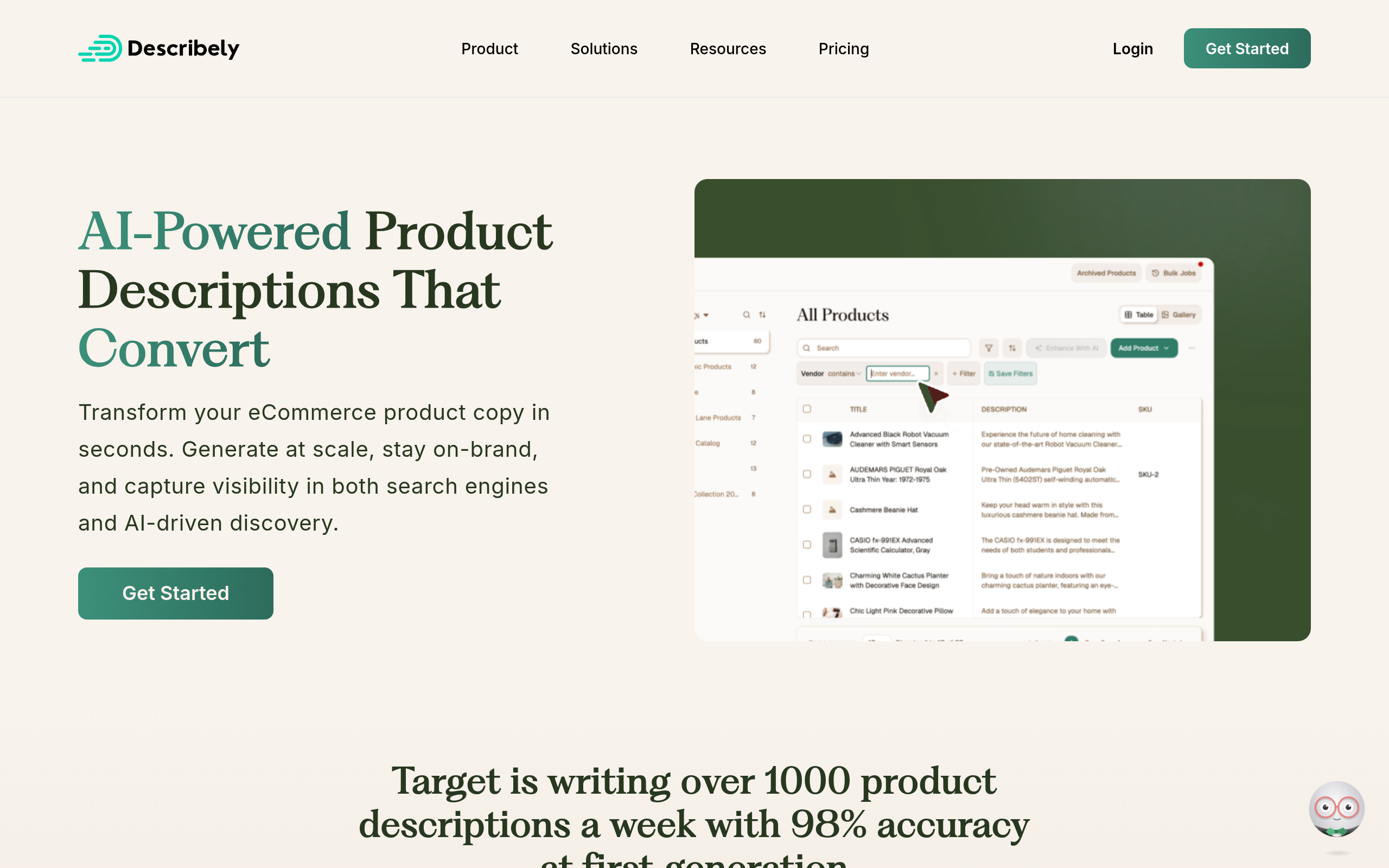
Describely is the most focused option for ecommerce catalog owners — built specifically for product descriptions (not general AI writing), it accepts CSV uploads and generates content that fits platform character limits. For sellers with hundreds of SKUs who need descriptions ready quickly, this is the logical starting point.
CopyMonkey is the Amazon specialist on this list. It understands A9 algorithm signals, generates backend keyword fields alongside listing copy, and produces output in Amazon's required bullet-point format. Nothing else here goes as deep on Amazon-specific optimization.
Jasper is the enterprise choice. If you have a formal brand style guide and need consistent copy across a large team and product catalog, Jasper's brand voice features are the most mature on the market. Its team collaboration tools also make it practical for organizations where multiple people touch product copy.
Anyword does something the others don't: it predicts conversion performance for each generated variant before you publish. For high-volume stores where a meaningful lift on top-SKU conversion rates is worth real money, the predictive scoring alone can justify the subscription cost.
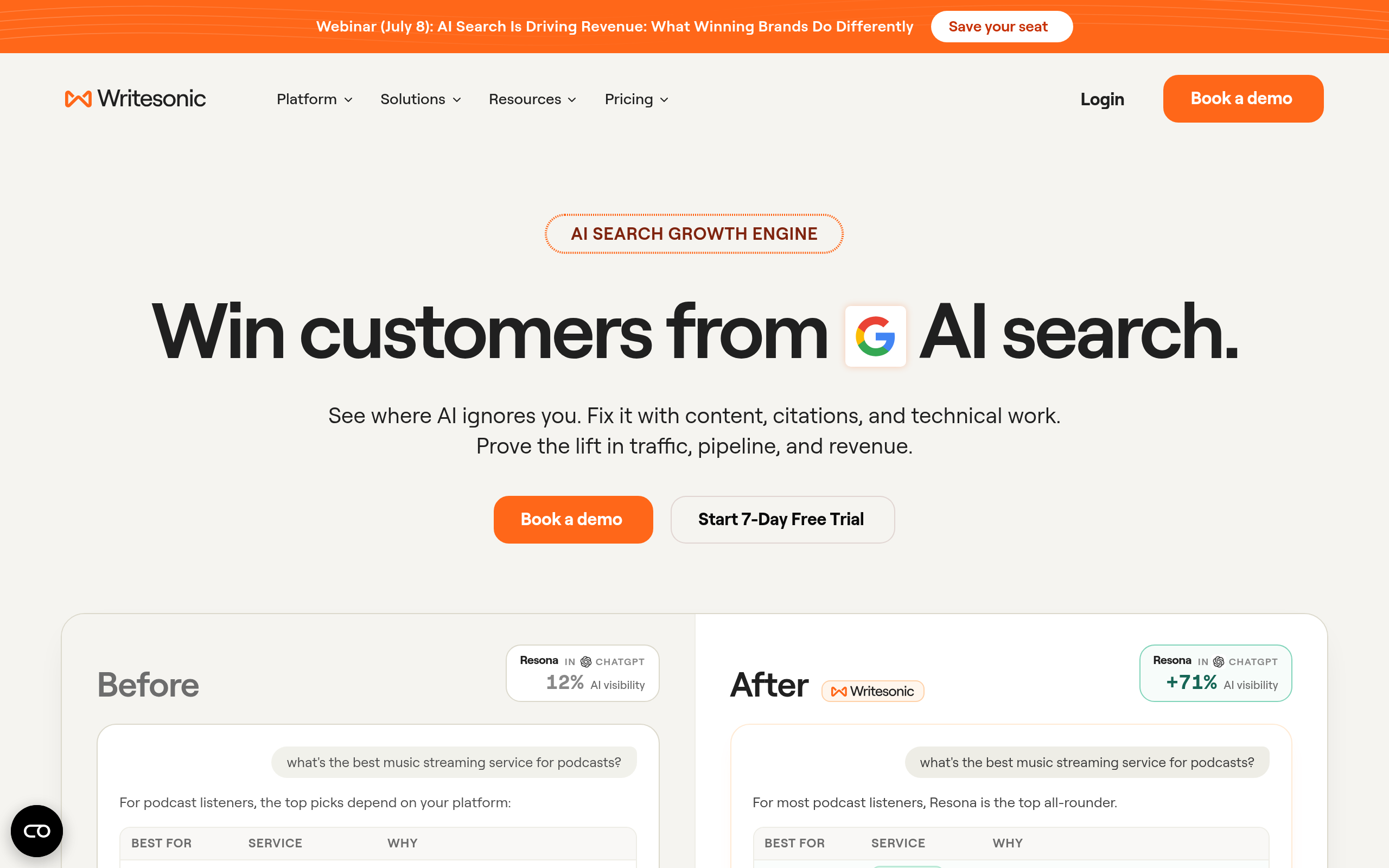
Writesonic offers the best balance of SEO keyword control, output quality, and accessibility for mid-market sellers. It has a free tier worth testing before committing to a paid plan, and supports both bulk description generation and meta description creation in the same workflow.
Copy.ai shines for content teams producing multiple content types — descriptions, blog posts, email, social — and wanting one platform to manage it all. Its workflow automation handles product lists efficiently and the brand kit feature keeps tone consistent across formats.
GravityWrite is the budget-conscious alternative with competitive output quality for straightforward products. Worth testing on a free tier before deciding you need a premium plan.
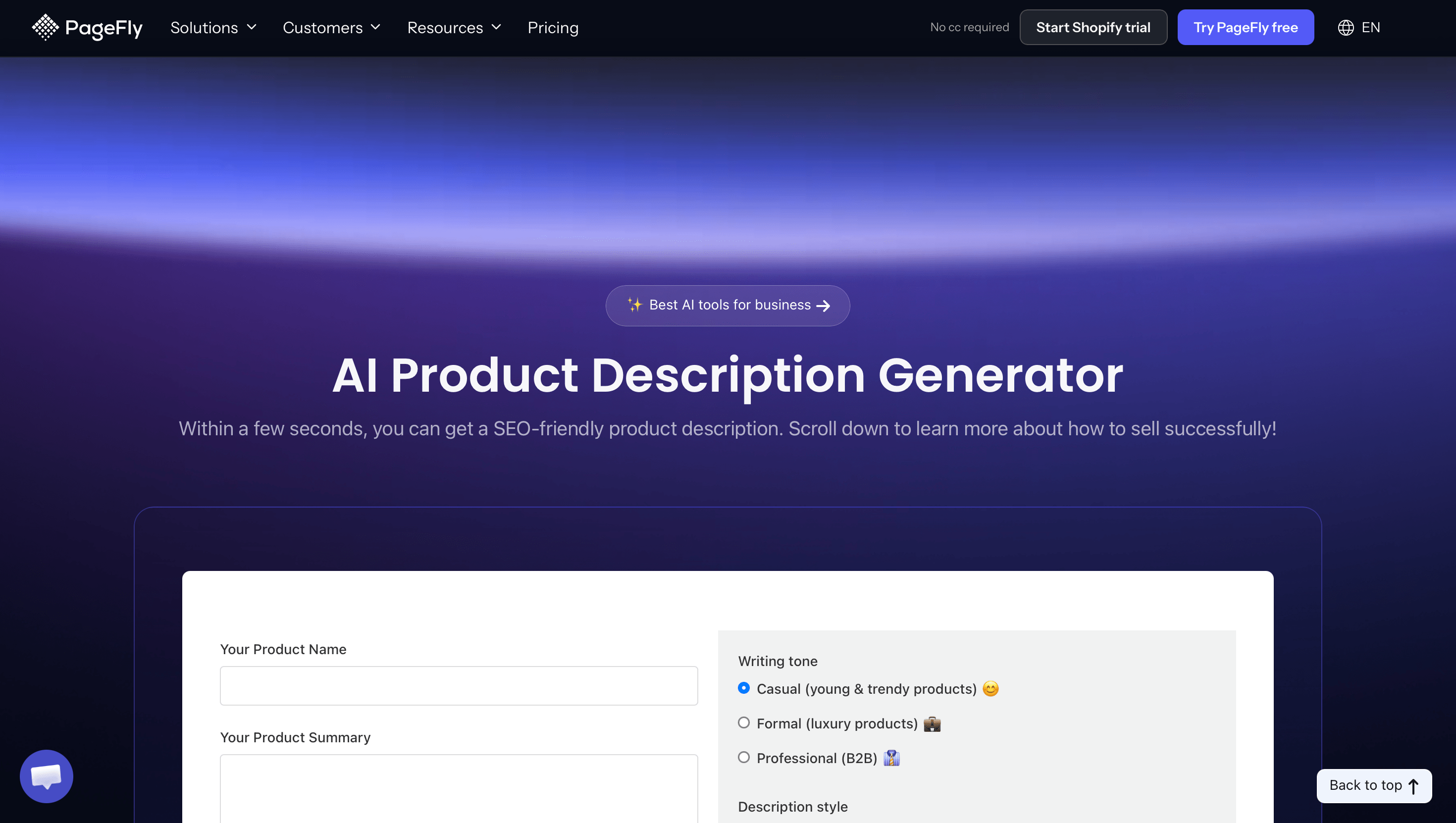
PageFly AI Product Description Generator integrates natively into the PageFly Shopify ecosystem. If you're already building Shopify landing pages in PageFly, this eliminates the need to transfer product data between platforms entirely.
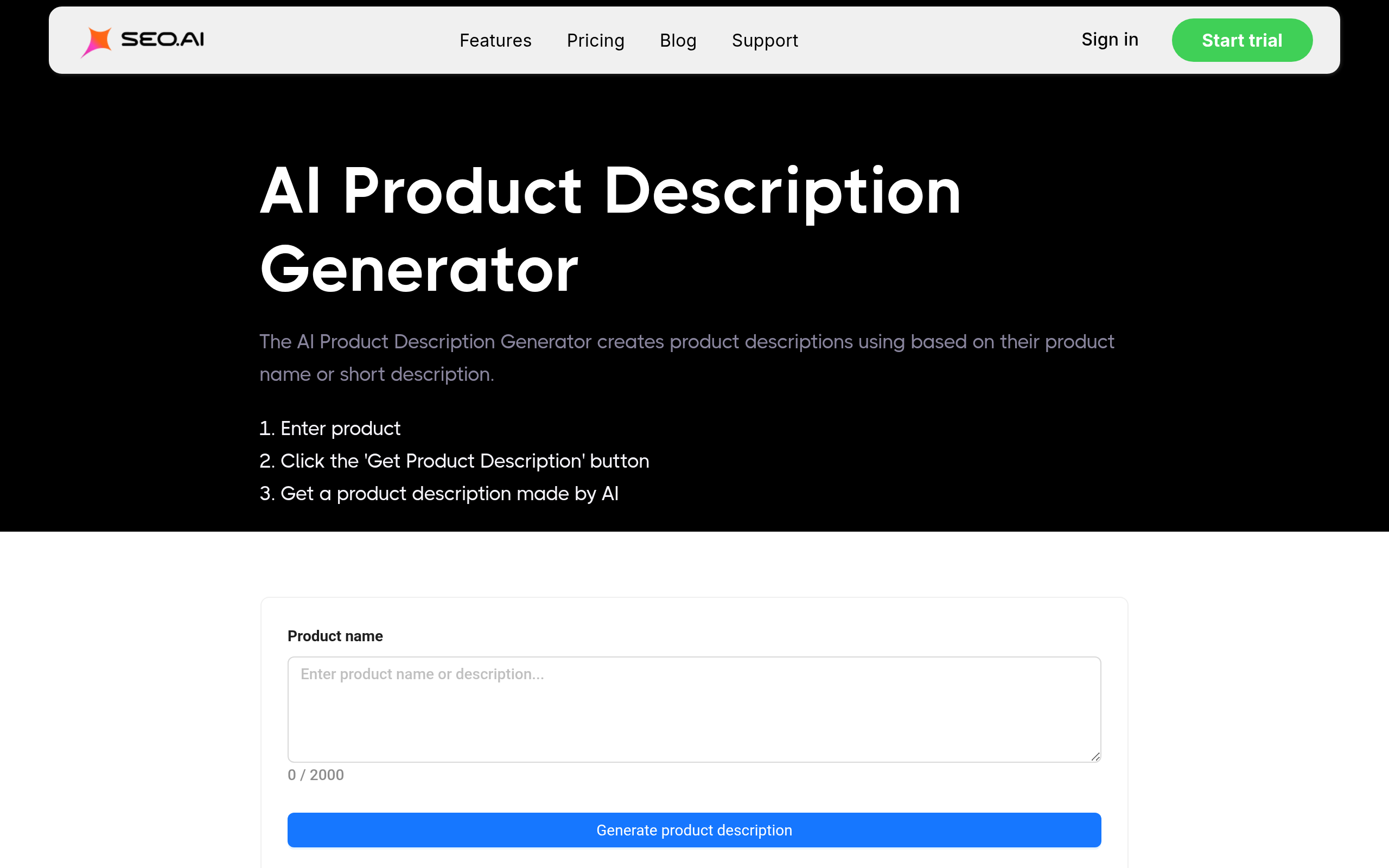
AI Product Description Generator serves the "I need one description right now" use case well, but is not designed for bulk catalog workflows.
Hoppy Copy — our affiliate partner — is a strong tool, but honestly framed: its core strength is email marketing copy, not on-page product listings. Use it for your product launch announcement sequences, abandoned cart flows, and post-purchase upsell campaigns. For on-page descriptions at scale, the other tools in this list are more purpose-built. We recommend Hoppy Copy specifically where it genuinely excels: email.
How Do You Build a Bulk AI Product Description Workflow?
The workflow that works for sellers with 100+ SKUs:
- Export and structure your catalog. Pull your product list into a CSV with consistent columns: product name, category, 3–5 key features (comma-separated), target buyer persona (one sentence), and any keywords you want embedded. Input quality determines output quality — this step is worth more time than sellers usually give it.
- Choose your tool based on platform. Amazon sellers: CopyMonkey. Shopify stores building with PageFly: PageFly AI Product Description Generator. General ecommerce (Shopify, WooCommerce, BigCommerce): Describely or Writesonic. Enterprise teams with brand style guides: Jasper.
- Set up a brand voice template before running the batch. Configure your tone (professional, approachable, technical, playful), output format (paragraph, bullets, hybrid), and phrases to avoid. In Jasper and Copy.ai, you can upload an actual style guide document — this is the most reliable method for brand consistency at scale.
- Run a pilot batch of 20–50 products first. Read the output critically. Adjust your prompt template or input data before scaling up. This step routinely surfaces problems in your input data structure that would otherwise affect thousands of descriptions.
- Run a similarity check on output. Similar products (same item in different colors, sizes, or bundles) often produce near-identical descriptions. A similarity or plagiarism check catches these before they reach your live catalog and create a duplication problem.
- Human review and light edit pass. AI handles the first draft. A human reviewer — or systematic spot-check of every 10th description — catches tonal drift, factual errors, and awkward phrasing in far less time than writing from scratch would take.
- Publish and monitor. Track impressions and click-through rates on newly described products in Google Search Console or your ecommerce analytics. Underperforming pages are candidates for A/B testing or manual rewrite.
How Do You Maintain Brand Voice When Generating Descriptions at Scale?
Brand voice drift is the most common failure mode in AI-generated content programs. After several hundred descriptions, subtle inconsistencies accumulate — and shoppers notice even if they can't name exactly what's off.
| Tool | Style Guide Upload | Tone Locking | Custom Vocabulary | Brand Voice Feature |
|---|---|---|---|---|
| Jasper | Yes (document upload) | Yes | Yes | Brand Voice |
| Copy.ai | Yes (document upload) | Yes | Yes | Brand Kit |
| Anyword | Partial (presets) | Yes | Limited | Tone of Voice |
| Describely | Partial (templates) | Yes | No | Tone Settings |
| Writesonic | No | Yes (selector) | No | Tone Selector |
| GravityWrite | No | Yes (presets) | No | Tone Presets |
For teams with formal brand guidelines, Jasper and Copy.ai are the right tools — both accept document uploads and reference them across all outputs. For smaller operations without a formal style guide, write 5–10 product description examples you're happy with and include them in your generation prompt as "write in this style." This works in any tool and dramatically improves consistency without a premium subscription.
Practical checklist before running any batch: define 3 adjectives that describe your brand voice (e.g., "direct, confident, unpretentious"); list 5 phrases or patterns to avoid (e.g., "revolutionary," "game-changing," excessive exclamation points); write 3 example descriptions you consider fully on-brand; lock these into your tool's voice settings before running.
How Do You Generate SEO-Optimized Product Descriptions with AI?
Ranking product pages in 2026 requires more than keyword density. Google's quality systems evaluate semantic relevance, entity coverage, and user engagement signals. Here is how to get AI to produce descriptions that actually rank:
- Feed target keywords explicitly. Don't assume the AI will guess. Specify: "naturally include the phrase 'waterproof trail running shoes for women' in the first sentence." Explicit instruction produces precise keyword placement that reads naturally rather than stuffed.
- Lead with benefits, not specs. "Blocks 40dB of noise" is a spec. "You can hold a phone call on the subway without raising your voice" is a benefit. Benefit-led copy naturally incorporates semantic language around real use cases, which aligns with how people actually search.
- Generate meta descriptions at the same time. Writesonic and Anyword can produce the main description and its meta description in one pass. Consistent language between on-page copy and the SERP snippet reinforces click-through relevance.
- Generate multiple variants for high-traffic SKUs. Anyword scores predicted conversion performance for each variant before you publish, letting you pre-filter for the strongest version without running a full A/B test first.
| Tool | Keyword Input Field | Meta Description Gen | Performance Score | Long-tail Variants |
|---|---|---|---|---|
| Anyword | Yes | Yes | Yes (predictive) | Yes |
| Writesonic | Yes | Yes | No | Yes |
| Jasper | Yes | Yes | No | Yes |
| CopyMonkey | Yes (A9 fields) | No | No | Limited |
| Describely | Limited | No | No | Yes |
| GravityWrite | Yes | Yes | No | Yes |
For broader SEO and content marketing tools, see the Marketing & Growth category on Comparee.
Should You A/B Test AI-Generated Product Descriptions?
For high-traffic products — the SKUs driving most of your revenue — yes. A small conversion improvement on a top-10 listing is worth more than writing the perfect description for a slow-moving product. The math is straightforward: more traffic multiplied by even a small lift in conversion rate compounds quickly.
Anyword is the standout here: it scores each generated variant with a predicted performance rating before you publish. Generate 5 variations, compare their scores, publish the top 2 for a real traffic test, and let the data decide. This workflow compresses the traditional A/B testing cycle significantly and removes much of the guesswork from variant selection.
For teams using dedicated A/B testing platforms (VWO, Convert, or others): generate 2–3 variants in Writesonic or Copy.ai, load them into your testing tool, and track both conversion rate and add-to-cart rate — time-on-page alone doesn't tell you enough. Useful dimensions to test: benefit-led vs. feature-led opening lines; paragraph format vs. bullets vs. hybrid; professional tone vs. conversational; short (under 100 words) vs. long (200+ words) — optimal length varies meaningfully by product category and buyer intent.
How Do You Avoid Thin, Duplicate, and Penalizable AI Content?
Google's guidance on AI content reduces to one question: does this page genuinely serve the reader? AI-generated descriptions that are thin, interchangeable, or provide no unique insight beyond the manufacturer's product page underperform — and in high-duplication scenarios, may trigger quality filters at scale.
- Differentiate at the input level. If two products are nearly identical, your input CSV must capture what actually makes them different. The AI cannot invent differentiation that isn't in your data — supply it explicitly.
- Rotate prompt templates. If every description starts with the same sentence structure, similar products will produce near-identical output. Maintain 3–5 prompt variations and assign them across your catalog.
- Add unique product context. Model numbers, compatibility specs, specific use cases, real customer pain points, and origin stories make descriptions unique even when the surrounding structure is similar.
- Never skip the review pass. A 10% sample review catches systematic problems before they propagate across hundreds of live pages. This is non-negotiable at any scale.
| Tool | Free Tier | Anti-thin Mechanism | Right Scale | Platform Fit |
|---|---|---|---|---|
| Describely | Limited | Input structure + templates | Medium–Large catalog | Shopify, WooCommerce |
| CopyMonkey | No | Amazon format enforcement | Any Amazon seller | Amazon |
| Jasper | No | Style guide + team review | Enterprise | Any |
| Anyword | Limited | Performance scoring filters weak variants | Medium | Any |
| Writesonic | Yes | Keyword discipline + output variants | Small–Large | Any |
| GravityWrite | Yes | Manual review required | Small–Medium | Any |
Comparee's Verdict — Which AI Tool Should You Use for Product Descriptions?
Here is the specific breakdown by situation. No vague "it depends."
Amazon sellers: Use CopyMonkey. Built for A9 optimization, it understands backend keyword fields and produces listings in the format Amazon expects. Nothing else on this list is as specialized for Amazon's specific requirements and listing structure.
Shopify stores (product pages): Start with Describely for full-catalog batch work. If you're already building with PageFly, PageFly AI Product Description Generator is the obvious fit — native integration means no data transfers between platforms.
Enterprise teams with brand guidelines: Jasper. The brand voice and style guide features are the most mature on the market, and the team collaboration tools make it manageable at scale across multiple product lines and markets.
SEO-first operations: Writesonic for output volume and strong keyword control. Anyword if you want pre-publish performance scoring and can justify the premium cost — for high-SKU-count stores it pays for itself.
Multi-format content teams: Copy.ai if your team produces descriptions alongside blogs, social content, and email — one platform reduces tool-switching overhead and keeps brand kit settings consistent across formats.
Budget-conscious sellers: Both GravityWrite and Writesonic offer free tiers. Test both on a real batch before committing to a paid plan — output quality for straightforward products is competitive with pricier tools.
Quick one-offs: AI Product Description Generator for when you need a single description in two minutes without setting up a bulk workflow.
Product launch email campaigns: Hoppy Copy is the right tool for this use case — launch announcement sequences, abandoned cart recovery, and post-purchase upsell flows. As our affiliate partner, we recommend it specifically where it genuinely excels: email marketing, not on-page product listings where the other tools here are more purpose-built.
For most independent sellers starting out with AI descriptions: begin with Writesonic (free tier available, strong SEO features, clean bulk workflow), validate the process on 20–30 products, then evaluate whether upgrading to Describely or Anyword makes sense for your catalog size and conversion goals.
Tools mentioned in this guide


Pricing, features and model availability can change over time. Always verify current details on each tool's official website before deciding.
Frequently Asked Questions
Is AI-generated product copy allowed on Amazon and Shopify?
Is AI-generated product copy allowed on Amazon and Shopify?
How many product descriptions can I generate per hour with these tools?
How many product descriptions can I generate per hour with these tools?
Will AI product descriptions hurt my SEO rankings?
Will AI product descriptions hurt my SEO rankings?
What input data do I need to give the AI for good results?
What input data do I need to give the AI for good results?
Can I use ChatGPT directly instead of a specialized product description tool?
Can I use ChatGPT directly instead of a specialized product description tool?
How do I prevent AI from inventing product specifications?
How do I prevent AI from inventing product specifications?
Do I need to disclose that product descriptions are AI-generated?
Do I need to disclose that product descriptions are AI-generated?
Which tool works best for products with very technical specifications?
Which tool works best for products with very technical specifications?
Don't just pick a tool — get the whole workflow
Tell Comparee your goal and get a complete step-by-step AI workflow with the right tool for every step.