AI for SEO in 2026: The Complete Guide (Including GEO)
AI for SEO in 2026 — how to use AI for keyword research, content and audits, plus GEO: getting cited by ChatGPT, Perplexity and Gemini.
Key takeaways
- AI accelerates SEO — keyword research, content drafting, technical audits, and analysis — but it does not replace strategy or quality.
- The big shift in 2026 is GEO (Generative Engine Optimization): getting cited by AI answers in ChatGPT, Perplexity and Gemini, not just ranking in Google.
- Good news: the fundamentals overlap — accurate, well-structured, authoritative content wins both search and AI citations.
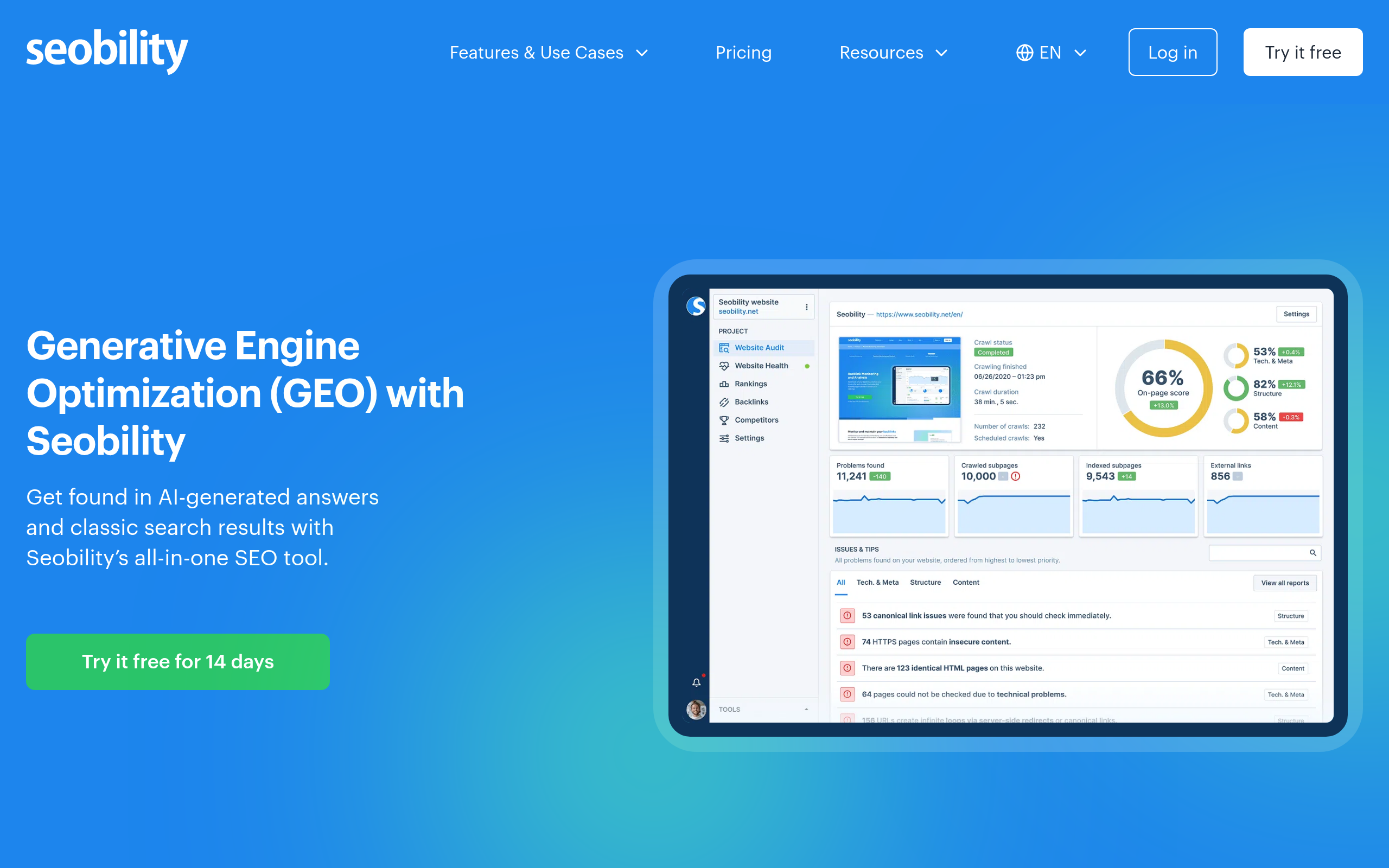
- Best tools include Semrush and Ahrefs for research, Surfer and NeuralText for content, Seobility for audits.
- Use AI to scale the work, but keep human judgement on strategy, accuracy and originality.
Using AI for SEO means applying AI to speed up keyword research, content creation, technical audits and analysis — while the bigger 2026 shift is GEO (Generative Engine Optimization): optimising to be cited by AI answer engines like ChatGPT, Perplexity and Google's AI overviews, not just to rank in classic search. The encouraging part is that the two reinforce each other: the accurate, well-structured, authoritative content that ranks in Google is exactly what AI engines cite. This guide covers how to use AI across the SEO workflow, what GEO is and how to win at it, the best tools, and the mistakes that get sites penalised.
How AI helps with SEO
AI is a force multiplier across the SEO workflow, not a magic ranking button. In keyword and topic research, it helps you find opportunities, cluster topics and understand intent faster. In content, it drafts, outlines and expands — turning a blank page into a starting point. In technical SEO, AI-assisted audits surface issues (broken links, thin pages, slow loads) at scale. In analysis, it summarises performance and competitor data. The key word is assist: AI handles the volume and the grunt work, but the strategy, the accuracy and the originality still come from you. Sites that hand the whole job to AI and publish unedited output tend to produce thin, generic content that does not rank — and may be penalised.
What is GEO (Generative Engine Optimization)?
GEO is the practice of optimising your content to be referenced and cited by AI answer engines. Increasingly, people get answers directly from ChatGPT, Perplexity, Gemini and Google's AI overviews rather than clicking blue links. If your content is the source those engines cite, you earn visibility and authority even when the user never visits a traditional search results page. GEO is not a replacement for SEO — it is an extension of it. The signals overlap heavily: clear structure, factual accuracy, direct answers, and demonstrable authority all help an AI decide your page is worth quoting.
How to optimise for AI citations (GEO tactics)
- Answer directly and early — state the answer to the page's core question in the first sentence or two. AI engines lift clear, self-contained answers.
- Structure for extraction — use clear headings, short paragraphs, lists and tables. Machines parse structure.
- Be accurate and specific — cite facts, define terms, and avoid fluff. AI favours precise, verifiable content.
- Add FAQs — directly answering long-tail questions matches how people query AI.
- Demonstrate authority (E-E-A-T) — real expertise, sources, and a trustworthy site help AI trust your page.
- Keep it fresh — up-to-date content is more likely to be cited.
Notice that every one of these also helps classic SEO. That is the point: do the fundamentals exceptionally well and you win both.
Best AI SEO tools in 2026
| Job | Best tools |
|---|---|
| Research & all-round platform | Semrush, Ahrefs |
| Content optimization | Surfer, NeuralText |
| Site audits | Seobility |
For research, competitor analysis and an all-round platform, Semrush and Ahrefs are the standards. For optimising the content itself around search intent — and increasingly for AI citability — Surfer and NeuralText guide structure and depth. And for affordable technical audits, Seobility finds and fixes issues. Compare more in our best AI SEO tools guide and the SEO & LLM visibility category.
Common mistakes (that get sites penalised)
The most damaging mistake is publishing unedited AI content at scale — search engines and AI engines both reward genuine value and demote thin, generic, mass-produced pages. AI should accelerate good content, not replace the human judgement that makes it good. The second mistake is chasing keywords over intent: ranking for a term means nothing if the page does not actually answer what the searcher wanted. The third is ignoring accuracy — AI can confidently state wrong facts, and a single error can cost you trust with both readers and AI engines. And the fourth is treating GEO as separate from SEO; in reality, the same quality work wins both, so do not split your effort.
How AI changed the SEO game
For years, SEO was a game of doing more — more keywords, more pages, more links — and AI made "more" almost free, which paradoxically made it worthless. When anyone can generate a thousand articles overnight, volume stops being a moat, and search engines responded by leaning harder into quality, expertise and genuine usefulness. The result is a counterintuitive truth: AI raises the floor on content production but also raises the bar on what actually ranks. The winners are not the sites that publish the most AI text; they are the ones that use AI to do their best work faster — deeper research, tighter drafts, better audits — while keeping a human firmly in charge of accuracy, originality and strategy. AI is a power tool, and like any power tool it makes a skilled operator faster and an unskilled one dangerous.
Building a practical AI-assisted SEO workflow
A sensible workflow uses AI at each stage without surrendering judgement. Start with AI-assisted research to find topics and understand intent, then bring human strategy to decide what is actually worth writing. Use AI to draft and expand, then edit hard for accuracy, voice and originality — the edit is where thin content becomes valuable content. Run AI-assisted technical audits to catch issues at scale, and prioritise fixes by impact. Finally, structure everything for both search and AI citation — direct answers, clean headings, FAQs, real authority. This is the same content that ranks in Google and gets quoted by AI engines, so you are not doing double work; you are doing the fundamentals well enough that both reward you. Pick the right tools for each stage, keep the human in the loop, and AI becomes a multiplier rather than a liability.
The bottom line
AI is the most powerful SEO accelerator available in 2026 — for research, content and audits — but it amplifies your strategy rather than replacing it. The real shift is GEO: as people get answers from AI engines, the goal expands from ranking links to being the cited source, and the winning move is the same fundamentals done exceptionally well — accurate, structured, authoritative, up-to-date content. Use Semrush or Ahrefs for research, Surfer or NeuralText for content, and Seobility for audits, keep humans on quality, and you will earn visibility in both Google and the AI answers that increasingly sit on top of it.
Disclaimer: SEO and GEO results depend on genuine content quality and authority. AI tools accelerate the work but do not guarantee rankings; always edit and fact-check AI-assisted content.
Tools mentioned in this guide
Pricing, features and model availability can change over time. Always verify current details on each tool's official website before deciding.
Frequently Asked Questions
How do I use AI for SEO?
How do I use AI for SEO?
What is GEO (Generative Engine Optimization)?
What is GEO (Generative Engine Optimization)?
How do I get my content cited by AI?
How do I get my content cited by AI?
What are the best AI SEO tools?
What are the best AI SEO tools?
Will AI content hurt my SEO?
Will AI content hurt my SEO?
Is GEO replacing SEO?
Is GEO replacing SEO?
Don't just pick a tool — get the whole workflow
Tell Comparee your goal and get a complete step-by-step AI workflow with the right tool for every step.