Best AI Tools for Ecommerce Product Recommendations
Compare the best AI tools for ecommerce product recommendations. Clerk.io, Nosto, LimeSpot, Recombee and more — find the right fit for your store.
- Best overall: Clerk.io — unified AI search, on-site recommendations, and email personalization in one platform, ideal for mid-to-large stores.
- Best for Shopify (no-code): LimeSpot — live in minutes, generous free tier, strong A/B testing built in.
- Best for developers: Recombee — flexible recommendation API with a free plan, fits any headless or custom storefront.
- Best enterprise option: Dynamic Yield — omnichannel personalization at scale for high-SKU catalogs.
- Best catalog enrichment: Hypotenuse AI — bulk AI product descriptions and metadata that make every recommendation engine perform better.
- Free tiers available: LimeSpot, Recombee, Hypotenuse AI, and PagePilot.ai all let you start at no cost.
The best AI tools for ecommerce product recommendations are Clerk.io, Nosto, LimeSpot, Recombee, Dynamic Yield, and Barilliance — each applying machine learning to shopper behavior to surface the right product at the right moment. For most growing stores, Clerk.io delivers the strongest combination of on-site recommendations, AI search, and email personalization from a single platform. If you run on Shopify and want zero developer work, LimeSpot is the fastest path to live recommendations. Read on for a full breakdown of each tool, who it suits, and what to watch out for.
Quick Verdict: Best AI Recommendation Tools at a Glance
| Tool | Best For | Free Tier | Setup Complexity | In Comparee Catalog |
|---|---|---|---|---|
| Clerk.io | Mid-to-large stores, omnichannel | No (trial) | Medium | No |
| Nosto | Fashion & lifestyle, deep personalization | No (trial) | Medium | No |
| LimeSpot | Shopify stores, quick setup | Yes | Low | No |
| Recombee | Developer-first, custom logic | Yes | High | No |
| Dynamic Yield | Enterprise, high-SKU catalogs | No | High | No |
| Barilliance | On-site + email bundle, mid-market | No | Medium | No |
| Hypotenuse AI | Catalog content enrichment | Yes | Low | Yes |
| PagePilot.ai | AI landing pages & product ads | Yes | Low | Yes |
How Do AI Product Recommendation Engines Actually Work?
Traditional recommendation engines used simple purchase-correlation rules: "customers who bought X also bought Y." Modern AI recommendation tools go much further by combining multiple signals simultaneously:
- Collaborative filtering — patterns from thousands of shoppers with similar browsing and purchase histories.
- Content-based filtering — product attributes, categories, tags, and descriptions that signal similarity between items.
- Session-based models — what a specific shopper has clicked, viewed, or added to cart in the current visit, even before login.
- Real-time business rules — inventory levels, margin targets, trending items, and promotional priorities layered on top of the algorithmic output.
The result: dynamic, personalized carousels that update per user across product pages, cart pages, the homepage, post-purchase emails, and search results. A well-tuned AI recommendation layer consistently lifts average order value and conversion rate — the exact improvement varies widely by store, vertical, and implementation quality, so treat any vendor benchmark as directional rather than a guarantee.
One underappreciated factor: product content quality. Recommendation engines learn from your catalog's metadata — titles, descriptions, tags, attributes. Thin, inconsistent, or duplicated product data produces worse recommendations regardless of the algorithm. That is where tools like Hypotenuse AI come in: generating accurate, structured product descriptions at scale gives recommendation models cleaner signals to work with.
What Are the Top AI Tools for Ecommerce Product Recommendations?
Clerk.io — Best Overall for Growing and Mid-Market Stores
Clerk.io is a Scandinavian-built platform that covers AI-powered site search, product recommendations, email automation, and audience segmentation under one roof. Recommendation widgets — frequently bought together, recently viewed, trending, personalized picks, similar products — install via a JavaScript snippet or native plugins for Shopify, Magento 2, WooCommerce, PrestaShop, and others.
What sets Clerk.io apart is its unified data model. Search behavior, recommendation clicks, and email engagement all feed the same underlying AI, so personalization improves across every channel simultaneously rather than in silos. Pricing scales with store revenue and request volume; a free trial is available.
Comparee's verdict: Clerk.io is the best choice for growing ecommerce stores that want a single vendor covering search, on-site recommendations, and email personalization with a single integration.
Nosto — Best for Fashion and Lifestyle Brands
Nosto is a veteran ecommerce personalization platform with particular strength in fashion, beauty, and lifestyle retail. Beyond product recommendations, it covers personalized content banners, pop-ups, behavioral segmentation, site search, and A/B testing — all managed from a visual merchandising layer on top of the AI engine.
Merchandisers can pin, exclude, or boost specific products without touching code. Business rules — "never show out-of-stock items," "prioritize high-margin SKUs" — apply instantly across all placements. Native integrations exist for Shopify Plus, BigCommerce, Magento, and Salesforce Commerce Cloud.
Comparee's verdict: Nosto is the best choice for fashion and lifestyle brands that need both algorithmic recommendations and precise visual merchandising control without relying on engineers for every change.
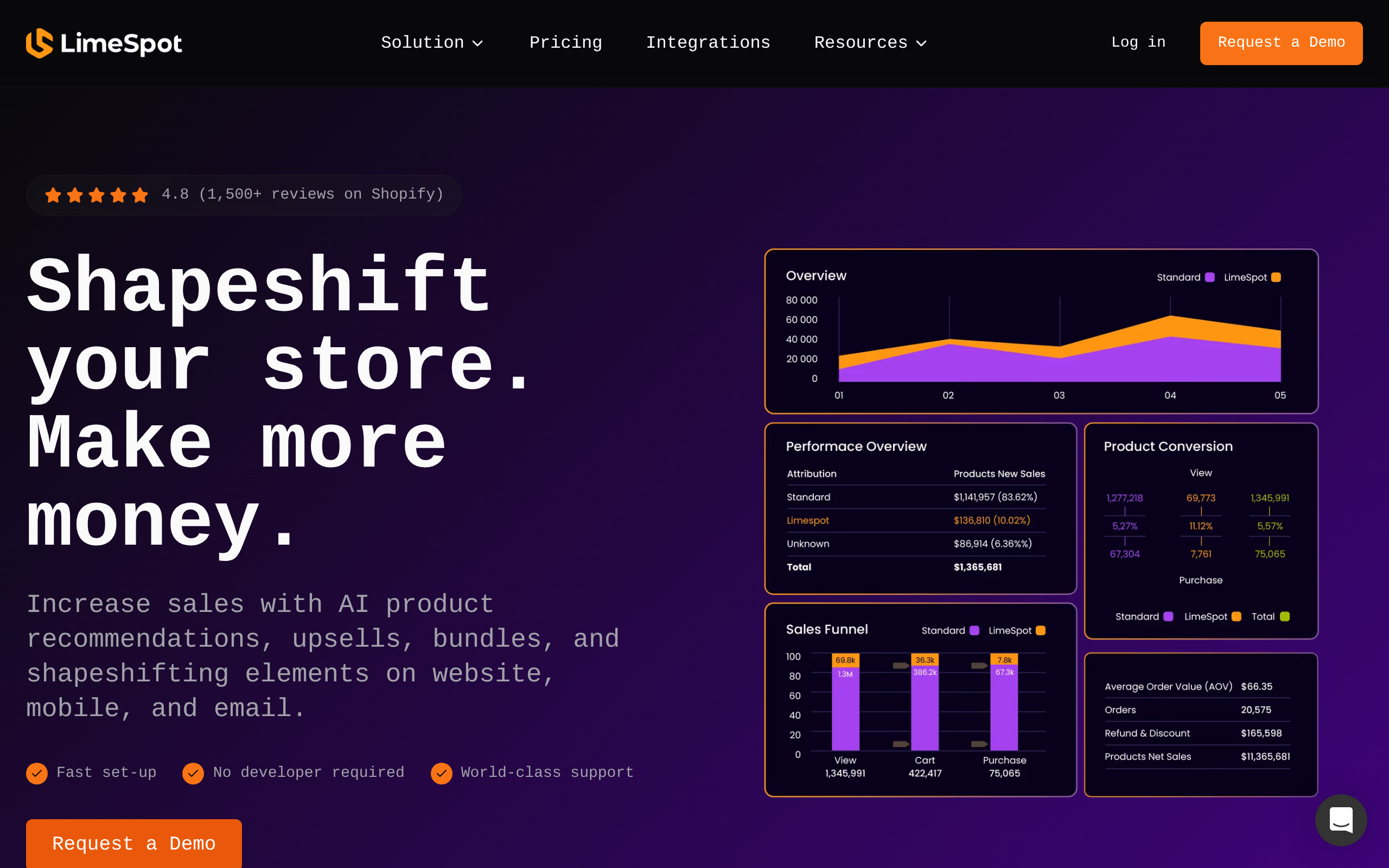
LimeSpot — Best for Shopify Stores with No Developer
LimeSpot is one of the highest-rated Shopify recommendation apps, used by tens of thousands of merchants. Installation requires no developer: you place recommendation widgets (also bought, related products, upsells, cross-sells, "you may also like") anywhere in your theme via a visual editor.
A free plan covers stores below a certain monthly revenue threshold, making it accessible for early-stage stores. Its built-in A/B testing compares widget placements and recommendation strategies with revenue-lift reporting attached to each experiment.
Comparee's verdict: LimeSpot is the best choice for Shopify merchants who want to be live with AI-powered product recommendations today, with no code, no contract, and a genuine free starting tier.
Recombee — Best for Developers and Headless Commerce
Recombee is a recommendation-as-a-service API developed in Prague and used by ecommerce stores, media platforms, and marketplaces worldwide. Unlike plug-and-play solutions, it is built for developers: you send interaction events (views, purchases, add-to-cart, ratings) and catalog data via REST or SDK, and receive ranked recommendation lists in response.
The payoff is complete flexibility. You can implement custom business logic, weight user properties, define A/B test scenarios across multiple recommendation models, and blend editorial picks with algorithmic output. A generous free tier covers smaller catalogs and monthly request volumes.
Comparee's verdict: Recombee is the best choice for development teams building headless commerce storefronts or custom platforms where recommendation logic must be embedded into the architecture rather than bolted on via a widget.
Dynamic Yield — Best Enterprise Recommendation Platform
Dynamic Yield (now part of Mastercard) is an enterprise-grade experience optimization platform used by major global retailers. It combines algorithmic product recommendations with A/B testing, content personalization, push notifications, and email triggers — all managed from a unified interface and attribution model.
The platform is designed for high-SKU catalogs and high-traffic environments where recommendation latency matters at millisecond scale. Implementation involves a dedicated solutions team; pricing is enterprise-tier and negotiated per contract.
Comparee's verdict: Dynamic Yield is the best choice for large retailers and brands with complex multi-channel catalogs, dedicated engineering resources, and budget for an enterprise vendor relationship.
Barilliance — Best for Bundled On-Site and Email Recommendations
Barilliance is an ecommerce personalization suite that bundles product recommendations, behavioral email triggers (cart abandonment, browse abandonment, post-purchase sequences), real-time pop-ups, and revenue attribution reporting in one platform.
Its main advantage over point solutions is the integrated view: every recommendation widget — whether shown on the site or in a triggered email — feeds the same behavioral data and reports against the same revenue metrics. Setup requires a JavaScript snippet and a product feed, with onboarding managed by their team.
Comparee's verdict: Barilliance is the best choice for mid-market stores that want on-site recommendations and email personalization from a single vendor without the complexity or cost of an enterprise platform.
Hypotenuse AI — Best for Catalog Content That Powers Better Recommendations
Hypotenuse AI is an AI content platform for ecommerce teams, and it belongs on this list for a reason most guides overlook: your catalog's content quality is the foundation every recommendation engine builds on.
Hypotenuse AI generates SEO-optimized product descriptions, category copy, and attribute metadata in bulk — from a spreadsheet, PIM export, or product images. When titles, tags, and descriptions are accurate, consistent, and richly structured, content-based recommendation filters produce more relevant results. It is catalog hygiene that amplifies the ROI of whatever recommendation platform you layer on top.
A free tier is available for smaller projects; paid plans scale to full team workflows with brand voice controls and multilingual output. You can explore it in the E-commerce & Retail category on Comparee.
Comparee's verdict: Hypotenuse AI is the best choice for ecommerce teams with large or inconsistent catalogs who want to improve recommendation relevance at the data layer before (or alongside) investing in a new recommendation engine.
PagePilot.ai — Best for Closing the Loop with AI Landing Pages
PagePilot.ai approaches ecommerce conversion from the destination end: AI-generated, product-specific landing pages and ad creatives built for Shopify stores. When a product recommendation drives a shopper to click, the landing page experience is what determines whether that click becomes a purchase.
PagePilot.ai lets you generate and test product-specific pages without a design team, creating dedicated experiences that match the recommendation context — particularly useful for paid social campaigns. It is not a recommendation engine itself, but it completes the funnel.
Comparee's verdict: PagePilot.ai is the best choice for DTC brands running paid acquisition who need fast, AI-generated landing pages that match the product context recommendations create. Free tier available.
Which AI Recommendation Tool Is Right for Your Store Size?
| Store Stage | Recommended Tools | Rationale |
|---|---|---|
| Early stage (<$500k GMV) | LimeSpot (free), Recombee (free API) | No upfront cost, easy to start; prove lift before committing budget |
| Growing ($500k–$5M GMV) | Clerk.io, Nosto, Barilliance | Solid ROI at this scale; multi-channel coverage pays off |
| Mid-market ($5M–$50M GMV) | Clerk.io, Nosto, Dynamic Yield | Need multi-channel sophistication and analytics depth |
| Enterprise ($50M+ GMV) | Dynamic Yield, Nosto | Complex catalog logic, dedicated implementation team, SLA requirements |
| Headless / custom build | Recombee | API-first, fits any frontend framework or custom architecture |
| Catalog with thin content | Hypotenuse AI (first) | Fix catalog quality before adding recommendation logic on top |
How to Choose an AI Recommendation Engine: Key Features to Compare
Not all recommendation tools are equal, and the wrong choice at the wrong stage wastes both money and engineering time. Before committing to any platform, evaluate these dimensions:
| Feature | What to Ask |
|---|---|
| Algorithm types | Does it support collaborative filtering, content-based, and session-based models — or just one? |
| Business rules | Can merchandisers pin, exclude, or boost products without code? |
| Placement options | Widgets on product pages, cart, homepage, search results, emails, and pop-ups? |
| A/B testing | Built-in experiment framework with direct revenue attribution per variant? |
| Platform integrations | Native connector for your ecommerce platform (Shopify, Magento, BigCommerce, headless)? |
| Analytics | Revenue-per-click, incremental lift, and per-widget performance dashboards? |
| Latency | How fast are recommendations served? Critical for high-traffic stores and Core Web Vitals. |
| Data privacy | GDPR/CCPA compliance, first-party data use, cookieless fallback for consent-declined users? |
One practical tip: always request revenue attribution reporting before signing. If a vendor cannot show you incremental lift — revenue generated by recommendations vs. a holdout control group — be skeptical of their ROI claims.
Pricing Models: What to Expect from AI Recommendation Tools
| Pricing Model | Who Uses It | Best Suited For |
|---|---|---|
| Free / freemium tier | LimeSpot, Recombee, Hypotenuse AI, PagePilot.ai | Early-stage stores; developers testing before committing |
| Revenue-based (% GMV) | Clerk.io, Nosto | Growing stores — cost scales proportionally with revenue growth |
| Per-request API pricing | Recombee (paid tiers) | High-volume or custom setups where usage varies month to month |
| Monthly flat fee (SMB) | Barilliance (lower tiers) | Predictable budgets; easier to justify to finance teams |
| Enterprise contract | Dynamic Yield, Barilliance (enterprise) | Large retailers with dedicated vendor budgets and procurement process |
Revenue-based pricing aligns vendor incentives with yours — they earn more when you sell more — but it can become expensive fast as you scale. If your GMV grows significantly, renegotiate or benchmark alternatives annually.
Comparee's Verdict: Which AI Recommendation Tool Should You Use?
- Comparee's verdict: Clerk.io is the best choice for growing ecommerce stores that want a single platform covering AI search, on-site recommendations, and email personalization. The unified data model means every channel improves together over time.
- Comparee's verdict: LimeSpot is the best choice for Shopify merchants who want to be live with recommendations today — no developer, no contract, free to start.
- Comparee's verdict: Recombee is the best choice for development teams building headless or custom storefronts that need full control over recommendation logic via API, with a free tier to begin.
- Comparee's verdict: Dynamic Yield is the best choice for enterprise retailers with complex multi-channel catalogs and the resources to implement and continuously optimize at scale.
- Comparee's verdict: Hypotenuse AI is the best choice for catalog enrichment — if your product metadata is thin or inconsistent, improving it with Hypotenuse AI will make every recommendation engine on this list perform better.
- Comparee's verdict: PagePilot.ai is the best choice for DTC brands running paid acquisition, where the AI landing page must match the recommendation context that brought the shopper there.
For a full view of available tools, browse the E-commerce & Retail category on Comparee. For tools that drive the traffic feeding these recommendation engines, see our Marketing & Growth tools section.
Tools mentioned in this guide

Pricing, features and model availability can change over time. Always verify current details on each tool's official website before deciding.
Frequently Asked Questions
What is the best AI tool for ecommerce product recommendations?
What is the best AI tool for ecommerce product recommendations?
Do I need a developer to set up AI product recommendations?
Do I need a developer to set up AI product recommendations?
How much do AI recommendation engines cost?
How much do AI recommendation engines cost?
What is the difference between collaborative filtering and content-based recommendations?
What is the difference between collaborative filtering and content-based recommendations?
How do AI product recommendations increase average order value?
How do AI product recommendations increase average order value?
Can AI recommendations work via email, not just on the website?
Can AI recommendations work via email, not just on the website?
How does product content quality affect recommendation performance?
How does product content quality affect recommendation performance?
Which AI recommendation tool is best for Shopify?
Which AI recommendation tool is best for Shopify?
Don't just pick a tool — get the whole workflow
Tell Comparee your goal and get a complete step-by-step AI workflow with the right tool for every step.