Best AI Tools for Code Review & Bug Detection in 2026
Best AI tools for code review & bug detection in 2026: CodeRabbit, Snyk Code, SonarCloud, DeepSource, Semgrep, Codacy — with clear verdicts by workflow and team
- CodeRabbit is the strongest choice for AI-native PR review — it reads the full diff in context, understands the intent of a change, and posts actionable line-by-line comments without CI configuration.
- Snyk Code and Semgrep lead for security-focused static analysis: Snyk Code wins on inter-file data flow analysis and low false positives; Semgrep wins on custom detection rule flexibility.
- SonarCloud and DeepSource are the benchmark platforms for code quality tracking — bugs, code smells, coverage, technical debt — natively integrated into CI/CD with merge-blocking quality gates.
- AI code review and SAST are not the same thing: AI review tools flag logic and design issues; SAST tools scan for known vulnerability patterns and compliance violations. Most teams benefit from both.
- The recommended default stack for most teams: CodeRabbit for AI PR review + SonarCloud for quality gates + Snyk Code for security SAST — all three have free tiers and install without infrastructure changes.
- All major tools reviewed here offer free tiers or open-source plans — there is no excuse to go without automated code review regardless of team budget or size.
If you are searching for the best AI tool for code review or bug detection in 2026, the direct answer is: it depends on what you are trying to catch. For AI-native PR review that comments like a senior engineer, CodeRabbit is the clearest answer. For security-focused static analysis in CI/CD, Snyk Code and Semgrep lead the market. For continuous code quality tracking with enforced merge gates, SonarCloud and DeepSource are the industry benchmarks. This guide covers all of them — with explicit verdicts on which tool fits which team and workflow — and is deliberately distinct from AI coding assistants like Cursor or Copilot, which help you write code rather than review it after the fact.
What Is the Difference Between AI Code Review and Traditional SAST?
These two tool categories are often conflated because they both analyze code for problems — but they operate differently and address different risks.
Traditional SAST (Static Application Security Testing) uses rule-based pattern matching against a database of known vulnerability signatures. Tools like SonarCloud and Semgrep scan for patterns matching SQL injection, XSS, hardcoded credentials, or insecure API usage — deterministic checks with known false-positive rates, auditable output, and direct mapping to security frameworks like OWASP and CWE. They run fast and integrate cleanly as hard CI gates.
AI-native code review tools like CodeRabbit use large language models to understand code semantically — reading the full PR diff, grasping the intent of a function, and flagging issues that have no rule equivalent: inconsistent error handling, missing edge case coverage, logic flaws in business rules, architectural regressions, or unclear naming that will cause future confusion. They can explain why something is a problem, not just flag that it matches a pattern.
The practical implication: SAST and AI code review are complementary layers, not substitutes. Security teams benefit from running both in the same pipeline.
| Dimension | AI Code Review (e.g., CodeRabbit) | SAST / Static Analysis (e.g., SonarCloud, Snyk Code) |
|---|---|---|
| Detection method | LLM semantic understanding of code intent and context | Rule-based pattern matching against vulnerability signatures |
| Best at catching | Logic bugs, design issues, missing edge cases, style regressions | Security vulnerabilities, known CVE patterns, compliance violations |
| Explainability | Natural language explanation with code context and suggested fix | Structured finding with rule ID, CWE or CVE reference |
| False positive profile | Higher, more context-dependent — requires reviewer judgment | Lower and deterministic — suppressible with annotations or config |
| Audit and compliance use | Not directly — narrative evidence only | Yes — maps to OWASP Top 10, PCI-DSS, SOC 2, ISO 27001 controls |
| Blocking merges | Usually configured as advisory (comment only) | Can be configured as hard merge gate on severity threshold |
Which AI Tools Are Best for Pull Request Code Review?
CodeRabbit
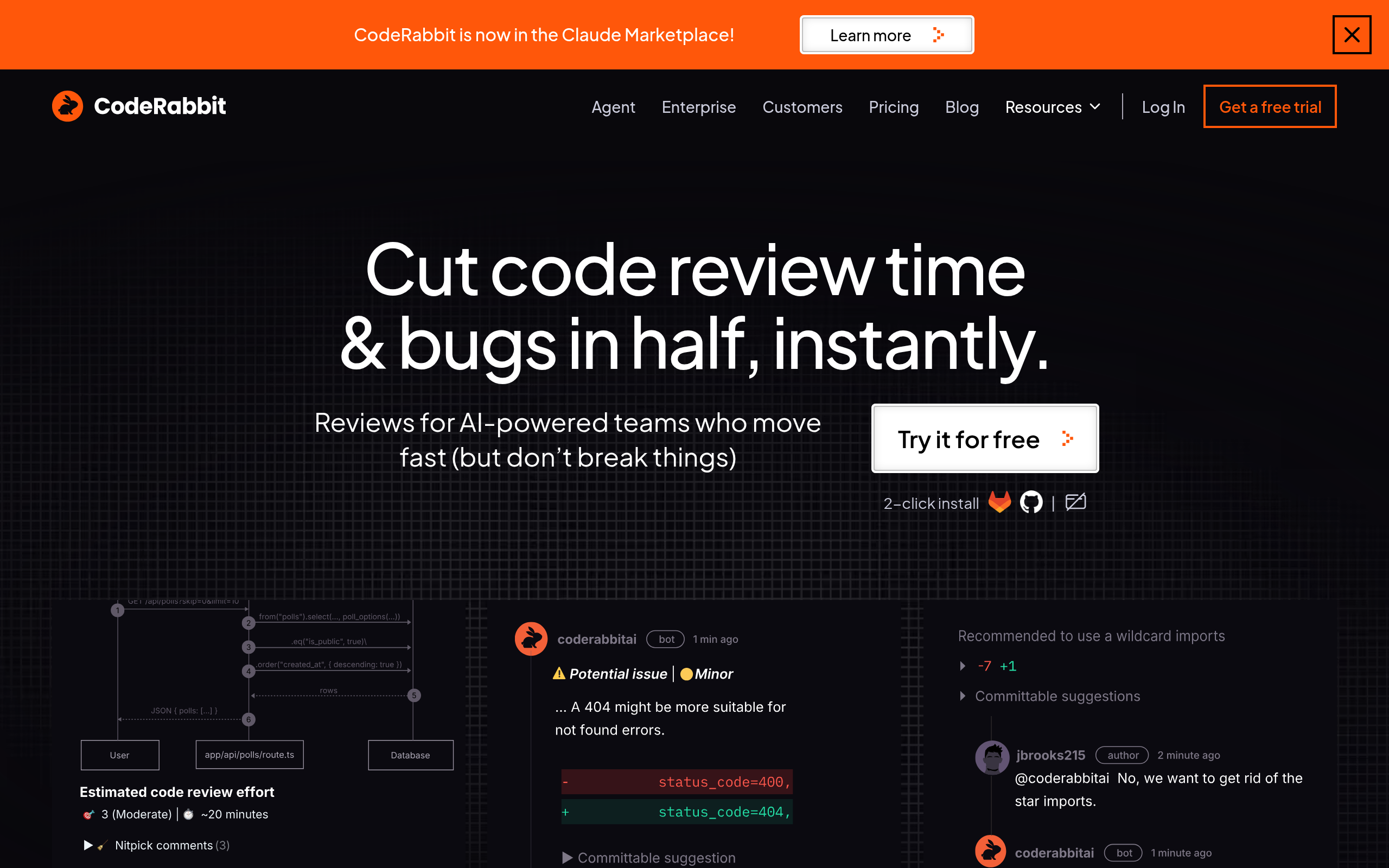
CodeRabbit is an AI code review platform purpose-built for GitHub and GitLab pull requests. Unlike tools that analyze files in isolation, CodeRabbit reads the entire diff in context — understanding what the PR is trying to accomplish before it posts a single comment. Its walkthrough summaries give reviewers an instant, plain-English overview of what changed and why, cutting the time senior engineers spend on PR orientation before they can give substantive feedback.
Line-by-line comments from CodeRabbit address code logic, potential bugs, missing error handling, test coverage gaps, and performance concerns. The system learns from feedback: when a reviewer dismisses a comment type repeatedly, CodeRabbit adjusts its future behavior across that repository. It installs as a GitHub or GitLab App in minutes with no YAML configuration required. There is a free tier for open-source repositories.
Amazon CodeGuru Reviewer
Amazon CodeGuru Reviewer is a machine learning-powered code review service trained on Amazon's internal codebase and millions of open-source repositories. It specializes in detecting resource leaks, concurrency issues, input validation errors, and AWS SDK anti-patterns in Java and Python. Findings appear as PR annotations with remediation guidance and code snippets. Pricing is usage-based per lines of code analyzed — no monthly minimum — which suits teams with infrequent review volumes better than high-throughput daily use.
Which SAST Tools Are Best for Bug Detection and Security in CI/CD?
Snyk Code
Snyk Code is Snyk's AI-powered static application security testing engine — separate from Snyk Open Source, which scans third-party dependencies. Snyk Code analyzes your own application code in real time via IDE plugins and as a CI gate, finding security vulnerabilities like injection flaws, insecure deserialization, path traversal, and broken authentication across JavaScript, TypeScript, Python, Java, Go, Ruby, C#, PHP, and more.
Its DeepCode AI engine performs inter-file data flow analysis rather than line-level pattern matching, which significantly reduces false positives compared to legacy SAST tools. This matters operationally: fewer false positives means developers actually act on findings instead of learning to ignore them. Snyk Code offers a free tier with limited monthly results.
SonarCloud
SonarCloud is the cloud-hosted version of SonarQube — the most widely deployed code quality platform in the enterprise market. It integrates natively with GitHub, GitLab, Bitbucket, and Azure DevOps, running analysis on every push and decorating PRs with findings on bugs, code smells, security hotspots, duplications, and test coverage gaps.
Its Quality Gate feature blocks merges when new code fails configured quality thresholds — enforcing standards as a hard CI gate rather than a suggestion. SonarCloud's AI CodeFix feature, available in paid tiers, suggests automated one-click fixes for detected issues directly in the PR. Public repositories on SonarCloud are free; private repositories are priced per line of code or per developer depending on the plan. Explore the full range of AI development tools in the Coding & Software Development category on Comparee.
DeepSource
DeepSource is an automated code review platform focused on static analysis for bugs, security issues, anti-patterns, and performance problems. It supports Python, JavaScript, TypeScript, Go, Rust, Ruby, Java, C, and C++, and installs as a GitHub or GitLab App that analyzes every commit without additional CI pipeline configuration. DeepSource's AI-assisted autofix feature generates ready-to-merge code patches directly in the PR for many detected issues, reducing developer remediation time. It offers a free tier for open-source projects and small teams.
Semgrep
Semgrep is an open-source static analysis engine with over 1,000 community-contributed and professionally audited security rules covering OWASP Top 10, CWE, and framework-specific patterns across 20+ languages. Its pattern syntax is designed to be readable and customizable: security engineers write rules that match company-specific anti-patterns, internal API misuse, or proprietary compliance requirements — not just the standard CVE catalog.
The open-source CLI runs locally or in any CI environment with no vendor lock-in. Semgrep Cloud Platform adds a managed rule registry, findings dashboard, diff-aware scanning (scanning only changed files in PRs for sub-30-second run times), and policy-based merge blocking. The free tier includes the full open-source engine and the standard rule registry; the cloud platform is usage-based.
Codacy
Codacy is a code quality platform that combines static analysis, code coverage tracking, duplication detection, and complexity metrics in a single team dashboard. It supports over 40 programming languages and integrates with GitHub, GitLab, and Bitbucket through an App-based setup requiring no CI YAML changes. Codacy's PR gate blocks merges when quality scores drop, and its coverage gate ensures new code is tested before it lands in main. It is a strong fit for teams managing multiple repositories in multiple languages who want a unified quality view without running separate tools per stack. Codacy offers a free tier for open-source projects.
Modal
Modal is a serverless cloud compute platform for Python workloads — running functions, batch jobs, and scheduled tasks without provisioning or managing infrastructure. In the context of code quality pipelines, Modal is used to run computationally intensive analysis at scale: executing custom linting and analysis scripts on large repositories, orchestrating multi-step code quality workflows that exceed standard CI runner time or memory limits, or hosting ML-based code analysis models internally. For teams building proprietary code analysis tooling or running full-repository audits on a schedule, Modal's pay-per-compute-second model is more cost-efficient than maintaining always-on analysis infrastructure. It offers a free tier with monthly compute credits.
How Do These Tools Compare Side by Side?
| Tool | Primary Use | Languages | CI Integration | Free Tier | Ideal Buyer |
|---|---|---|---|---|---|
| CodeRabbit | AI PR review | All (LLM-based) | GitHub App / GitLab App | Yes (open source) | Teams wanting AI senior-engineer review on every PR |
| Snyk Code | Security SAST | JS, TS, Python, Java, Go, Ruby, C#, PHP, more | GitHub, GitLab, Jenkins, CircleCI, more | Yes (limited monthly scans) | Security-first teams needing deep data flow analysis |
| SonarCloud | Code quality + security | 30+ languages | Native GitHub / GitLab / Azure DevOps / Bitbucket | Yes (public repos) | Teams enforcing quality gates and tracking technical debt |
| DeepSource | Bug detection + autofix | Python, JS, TS, Go, Rust, Ruby, Java, C/C++ | GitHub App / GitLab App | Yes (open source + small teams) | Teams wanting zero-config bug detection with autofixes |
| Semgrep | Customizable SAST | 20+ languages | Any CI (CLI) + Semgrep Cloud Platform | Yes (open-source engine) | Security engineers writing custom detection rules |
| Codacy | Code quality + coverage | 40+ languages | GitHub / GitLab / Bitbucket App | Yes (open source) | Multi-language teams wanting one quality dashboard |
| Amazon CodeGuru | ML PR review (Java / Python) | Java, Python | AWS CodePipeline, GitHub, Bitbucket | No (pay-per-LOC) | AWS-native teams on Java or Python codebases |
| Modal | Serverless compute for analysis pipelines | Python | Any CI (CLI-driven) | Yes (monthly credits) | Teams building custom code analysis tooling at scale |
Which AI Code Review Tool Fits Your Team Size and Workflow?
| Scenario | Primary Recommendation | Good Pairing | Pricing Pattern |
|---|---|---|---|
| Startup: small team, GitHub, fast review cycles | CodeRabbit | DeepSource | Both offer free tiers — zero upfront cost |
| Security-conscious team, any size | Snyk Code | Semgrep | Snyk: free tier + usage-based paid; Semgrep: free OSS engine |
| Enterprise: quality gates + compliance reporting | SonarCloud | Snyk Code | SonarCloud: per-LOC or per-developer annual; Snyk: per-developer tiers |
| Multi-language monorepo, many repositories | Codacy | SonarCloud | Codacy: per-repo or per-developer; SonarCloud: per-LOC |
| Security team writing internal detection rules | Semgrep | Snyk Code | Semgrep: free OSS CLI; Cloud Platform usage-based |
| AWS-native Java or Python shops | Amazon CodeGuru | SonarCloud | CodeGuru: pay-per-lines-analyzed — no monthly minimum |
| Teams building internal code analysis tooling | Modal | Semgrep | Modal: pay-per-compute-second; generous free monthly credits |
How Does AI Code Review Fit Into a CI/CD Pipeline?
Integrating AI code review into a modern CI/CD pipeline typically happens at three stages in the developer workflow:
- On every push (diff-aware scan): Tools like SonarCloud, DeepSource, and Semgrep run incrementally — analyzing only changed lines in each commit rather than re-scanning the entire codebase. This keeps scan times under two minutes even on repositories with millions of lines of code.
- On PR open or update (PR decoration): CodeRabbit, DeepSource, and SonarCloud post findings directly as GitHub or GitLab PR review comments. Developers see the analysis without leaving the PR interface, and reviewers see which issues are flagged before they begin their manual review.
- As a merge gate (quality gate): SonarCloud's Quality Gate and Codacy's quality threshold features block the merge button when new code introduces a net increase in bugs, security issues, or drops test coverage below a configured threshold. This enforces a code standard as an objective CI gate rather than relying on reviewer memory or discipline.
The most effective setups layer all three: Snyk Code or Semgrep as a security gate that blocks merges on high-severity findings, SonarCloud or DeepSource as a quality gate that blocks on coverage drop or bug increase, and CodeRabbit for AI review comments that flag issues for developer attention without hard-blocking every PR. Each layer has a distinct purpose and catches a distinct class of problem.
What Should You Look for in an AI Bug Detection Tool?
Not all static analysis tools are equal, and the right evaluation criteria depend on your team's priorities. The key questions to ask before committing to a tool:
- False positive rate: A tool with high false positives will be ignored within weeks. Ask vendors for false positive rates on your language stack, or run a trial on an existing repository and count how many findings are actually actionable.
- Language and framework coverage: Some tools specialize in a handful of languages (Amazon CodeGuru is Java and Python only). If you run a polyglot stack, prioritize tools like SonarCloud or Codacy with broad coverage.
- Autofix capabilities: DeepSource and SonarCloud (paid) generate automated patches for detected issues. For teams that want to reduce the manual remediation burden, autofix is a meaningful accelerator.
- Integration depth: App-based integrations (CodeRabbit, DeepSource, Codacy) require zero CI configuration changes. CLI-based tools (Semgrep, Snyk Code) require CI YAML changes but offer more configuration control. Both approaches work — choose based on your team's appetite for configuration overhead.
- Customization: If your codebase has internal libraries, proprietary APIs, or company-specific patterns that generic rules won't catch, Semgrep's custom rule syntax is the most accessible option in the market.
What Is Comparee's Verdict on the Best AI Code Review and Bug Detection Tools for 2026?
Comparee's verdict: here is the direct answer by buyer profile, no hedging.
- Best AI PR review, no configuration required: CodeRabbit is the clearest winner for teams wanting an AI reviewer that works out of the box — installs as a GitHub App in under two minutes, reads the full PR diff with context, and posts senior-engineer-quality comments. Nothing else in the market matches its PR-native review experience across all languages.
- Best security SAST with low false positives: Snyk Code is the right tool for security-first teams. Its inter-file data flow analysis understands how tainted data flows through your application rather than just matching vulnerable function signatures, which is why its false positive rate is significantly lower than legacy SAST alternatives. For teams that rely on developer trust in the tool, that matters more than raw detection coverage.
- Best all-around code quality platform for CI/CD: SonarCloud is the industry benchmark — widest language support, the most mature Quality Gate system, and native integrations with every major DevOps platform. If your team can only adopt one code quality tool, SonarCloud is the default choice.
- Best zero-configuration bug detection with autofixes: DeepSource wins for teams that want a bug detection tool working immediately after installing the GitHub App — no YAML config, no rule tuning, autofixes included. It is the lowest-friction entry point into automated code review for small teams.
- Best for security teams writing custom detection rules: Semgrep is the right tool when your security team has internal API patterns, compliance requirements, or company-specific anti-patterns that no off-the-shelf rule set covers. Its pattern syntax is the most readable and customizable in the SAST category, and the open-source engine means zero vendor lock-in.
- Best for multi-language quality dashboards across many repositories: Codacy is the strongest option for organizations running multiple languages across large numbers of repositories who want a single quality score, coverage tracking, and complexity dashboard without maintaining separate tool configurations per language.
For most engineering teams in 2026, the right starting stack is: CodeRabbit for AI PR review + SonarCloud for quality gates + Snyk Code for security scanning. All three offer free tiers, install without infrastructure changes, and address non-overlapping problem spaces in a single CI/CD pipeline.
Tools mentioned in this guide
Pricing, features and model availability can change over time. Always verify current details on each tool's official website before deciding.
Frequently Asked Questions
What is the best AI tool for code review in 2026?
What is the best AI tool for code review in 2026?
How is AI code review different from SAST tools like SonarQube?
How is AI code review different from SAST tools like SonarQube?
Can AI code review tools replace human code reviewers?
Can AI code review tools replace human code reviewers?
Which AI code review tool works best with GitHub?
Which AI code review tool works best with GitHub?
Is Snyk Code or Semgrep better for finding security vulnerabilities?
Is Snyk Code or Semgrep better for finding security vulnerabilities?
What is the difference between DeepSource and Codacy?
What is the difference between DeepSource and Codacy?
Does CodeRabbit work with private repositories?
Does CodeRabbit work with private repositories?
How do I integrate AI code review into my CI/CD pipeline without disrupting my workflow?
How do I integrate AI code review into my CI/CD pipeline without disrupting my workflow?
Don't just pick a tool — get the whole workflow
Tell Comparee your goal and get a complete step-by-step AI workflow with the right tool for every step.