Best AI Tools for Recruiting & Candidate Sourcing
Compare the best AI tools for recruiting and candidate sourcing in 2026. Find, attract, and engage top talent faster with AI-powered sourcing platforms.
- Top all-in-one pick: Workable Agent combines job-board distribution, AI candidate search, and pipeline tracking — reducing the number of tools your team needs to manage.
- Best for outreach automation: recruitRyte builds personalized multi-step recruiting sequences; Bardeen automates LinkedIn discovery without code.
- Best for talent pools: Talentpilot keeps passive candidates warm through AI-driven nurture workflows so you are not starting from zero each time a role opens.
- Best for lean teams: uRecruits and Mokka offer AI-assisted pipelines without enterprise pricing or setup complexity.
- This guide covers sourcing — finding and attracting candidates. For AI tools that handle interviews and evaluations, see the full HR & Recruiting directory on Comparee.
- Most tools here offer a free tier or trial. Meaningful sourcing volume typically requires a paid plan, but you can validate fit before committing.
The best AI tools for recruiting and candidate sourcing in 2026 are Workable Agent, recruitRyte, Talentpilot, and Bardeen. For teams that want a single platform, Workable Agent is the strongest starting point. If budget is tight, Bardeen's generous free tier covers LinkedIn sourcing without a dedicated recruiting tool. All four have free options so you can test before buying.
What Separates Candidate Sourcing from Screening — and Why Does It Matter for Tool Choice?
Sourcing is the front half of recruiting: identifying people who might be a fit, sparking their interest, and pulling them into your pipeline. Screening is everything after that — structured interviews, assessments, reference checks, offer negotiation. They require fundamentally different tooling.
AI sourcing tools typically do some combination of the following:
- Search LinkedIn, GitHub, job boards, and professional directories to surface matching profiles
- Draft and send personalized outreach emails or InMails at scale
- Distribute job postings across multiple boards simultaneously from a single interface
- Build and maintain talent pools of passive candidates for future roles
- Score inbound applicants against a job description before a human reads a single resume
Choosing a sourcing tool when you actually need a screening tool — or vice versa — is one of the most common (and expensive) mistakes recruiting teams make. This guide covers sourcing only. If you need AI-assisted interviewing or skills assessment, those are covered separately in our HR & Recruiting category.
Quick Verdict: Best AI Recruiting & Sourcing Tools at a Glance
| Tool | Best For | Free Option | Core Sourcing Strength |
|---|---|---|---|
| Workable Agent | Mid-size teams wanting one platform | Trial | Multi-board job posting + AI candidate search + pipeline |
| recruitRyte | High-volume personalized outreach | Free tier | Multi-step recruiter outreach sequences |
| Talentpilot | Long-term passive talent pools | Free tier | Candidate CRM + AI nurture sequences |
| Bardeen | Budget-conscious LinkedIn sourcing | Yes (generous) | No-code LinkedIn scraping + ATS push automation |
| uRecruits | Small agencies and startups | Free tier | Lightweight AI-assisted pipeline management |
| Mokka | HR generalists managing full people ops | Free tier | Recruiting within a broader HR suite |
| Jobright | Niche and technical role sourcing | Free tier | AI matching engine beyond keyword search |
| AIHR Screen | Source-to-first-filter in one tool | Free tier | Combined sourcing + initial candidate ranking |
The 8 Best AI Tools for Recruiting & Candidate Sourcing in 2026
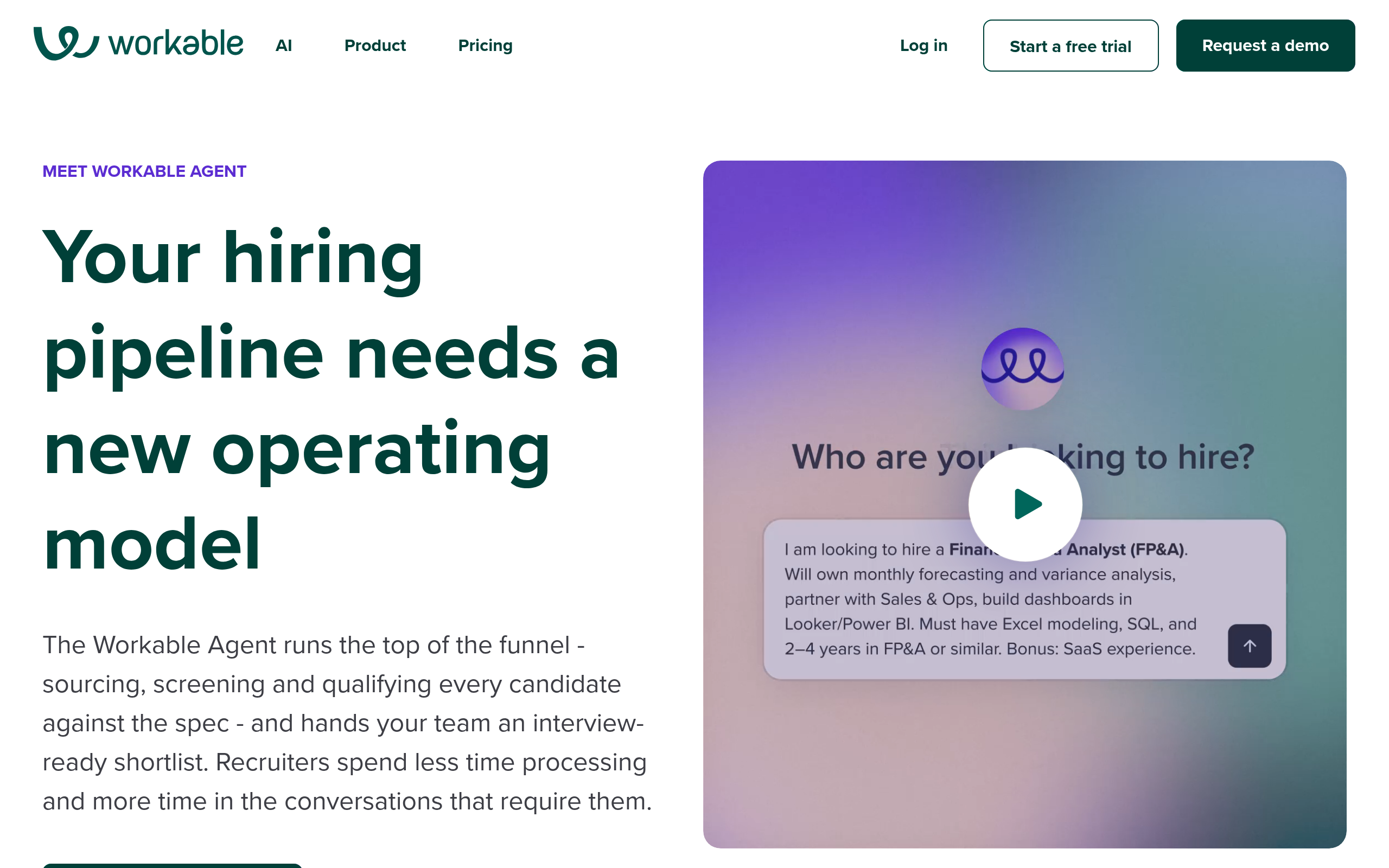
1. Workable Agent — Best All-in-One Sourcing Platform
Workable Agent extends the Workable recruiting platform with an AI agent layer that automates repetitive sourcing tasks. A single job posting gets distributed to dozens of boards simultaneously. The integrated AI candidate search surfaces relevant profiles from Workable's candidate database and public sources. Pipeline tracking keeps every candidate's status visible without spreadsheets or manual updates. For teams already using Workable as an ATS, the Agent features add sourcing power without introducing a new tool. For teams starting fresh, it is one of the more complete source-to-hire platforms in the category.
The AI agent capability is what distinguishes it: it can proactively surface candidates that match open roles, send initial interest checks, and move responses into the pipeline — with a human reviewing at each key decision point.
Best for: Mid-size companies (roughly 50–500 employees) that want job distribution, AI-assisted sourcing, and pipeline management without stitching together separate tools.
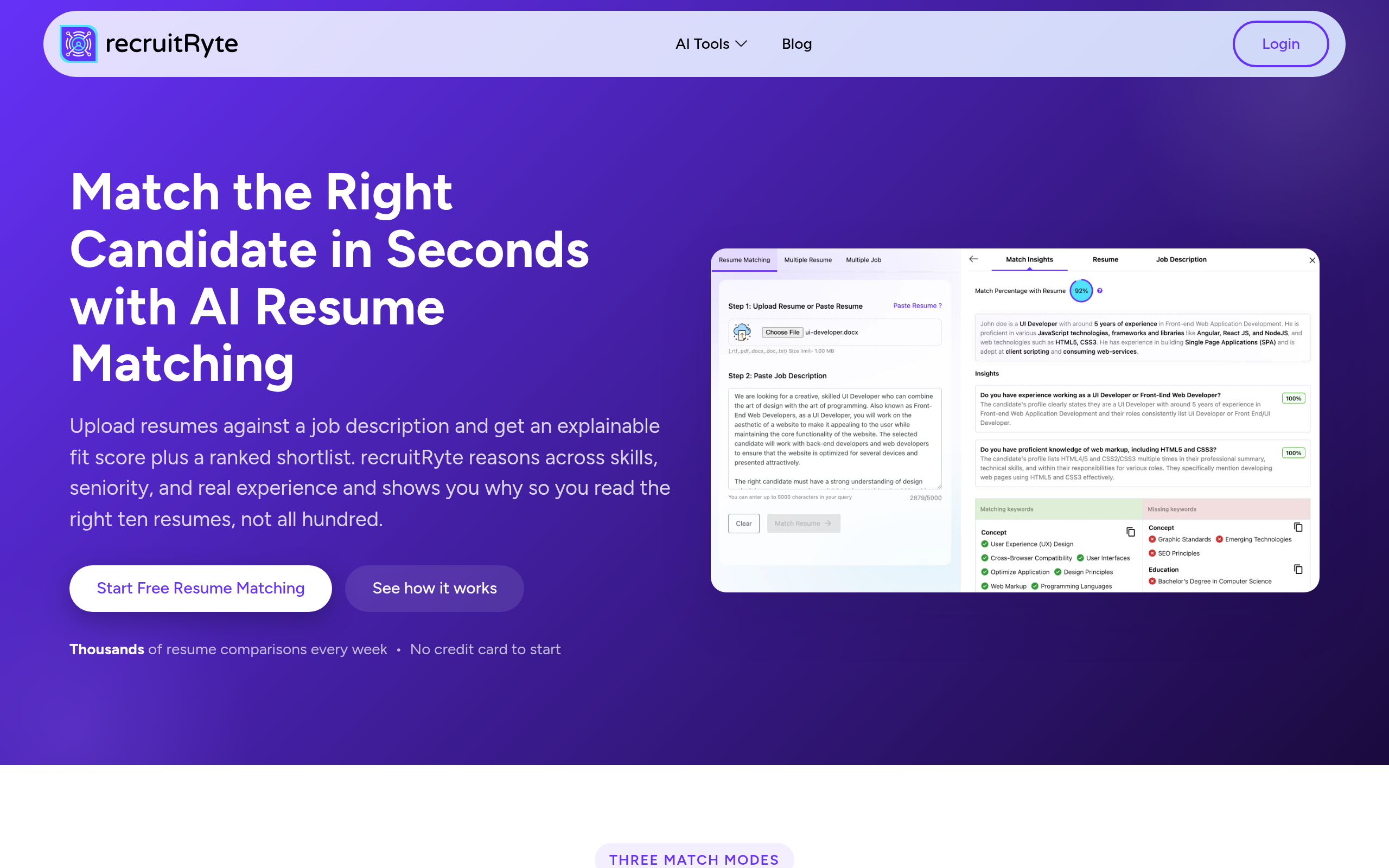
2. recruitRyte — Best for Outreach-First Sourcing
recruitRyte is purpose-built for the outreach side of candidate sourcing. It generates personalized outreach messages based on candidate profile signals and your job requirements, then manages multi-step sequences to maximize response rates. The AI adapts tone and content by role type — a message to a senior engineer is written differently than one to a marketing hire. This matters because generic "I came across your profile" messages are routinely ignored, and most sales-adapted email tools do not understand recruiter context.
recruitRyte sits in a narrow but valuable position: it does not replace your sourcing channels, but it makes your outreach from those channels significantly more effective.
Best for: Recruiting teams that already have sourcing channels — LinkedIn, job boards, referrals — but struggle to convert discovered candidates into conversations.
3. Talentpilot — Best for Building Passive Talent Pipelines
Talentpilot tackles a problem that most sourcing tools ignore: what happens to strong candidates who are not ready to move right now? It functions as a candidate CRM — a structured, AI-assisted system for staying in touch with passive talent over months or years. Automated nurture sequences keep your company visible without spamming. When a relevant role opens, you have a warm pool to activate instead of starting a sourcing sprint from scratch.
This is especially valuable for companies that hire the same roles repeatedly — engineering, sales, customer success — where a maintained talent pool can cut time-to-fill by weeks.
Best for: Growth-stage startups and scaleups with predictable hiring patterns, or any recruiting team tired of rebuilding pipelines for recurring role types.
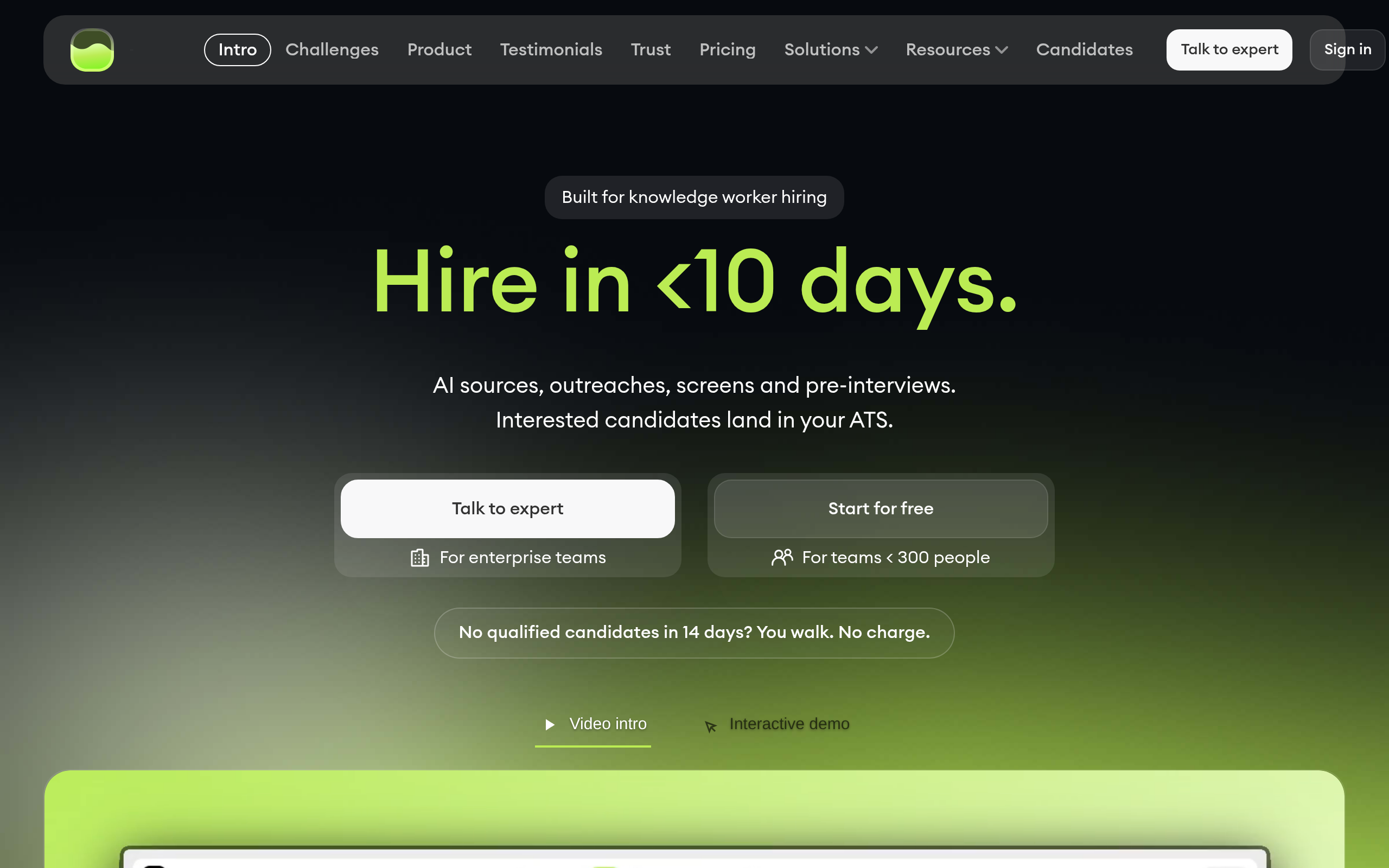
4. Bardeen — Best for No-Code LinkedIn Sourcing Automation
Bardeen is a browser automation platform that recruiting teams have adopted heavily as a DIY sourcing layer. Pre-built playbooks let you scrape LinkedIn search results, enrich profiles with contact information, and push data directly into your ATS or a spreadsheet — without writing code or paying for LinkedIn Recruiter's premium tiers. The recruiting automation library is extensive, and custom playbooks take minutes to configure.
The free tier is genuinely functional for low-volume sourcing: most small teams can run meaningful sourcing campaigns without spending anything. At scale, credit costs add up, but even paid Bardeen is cheaper than most dedicated sourcing platforms.
Best for: Recruiters who want to automate LinkedIn sourcing on a tight budget, or any team that wants a flexible automation layer on top of their existing tools.
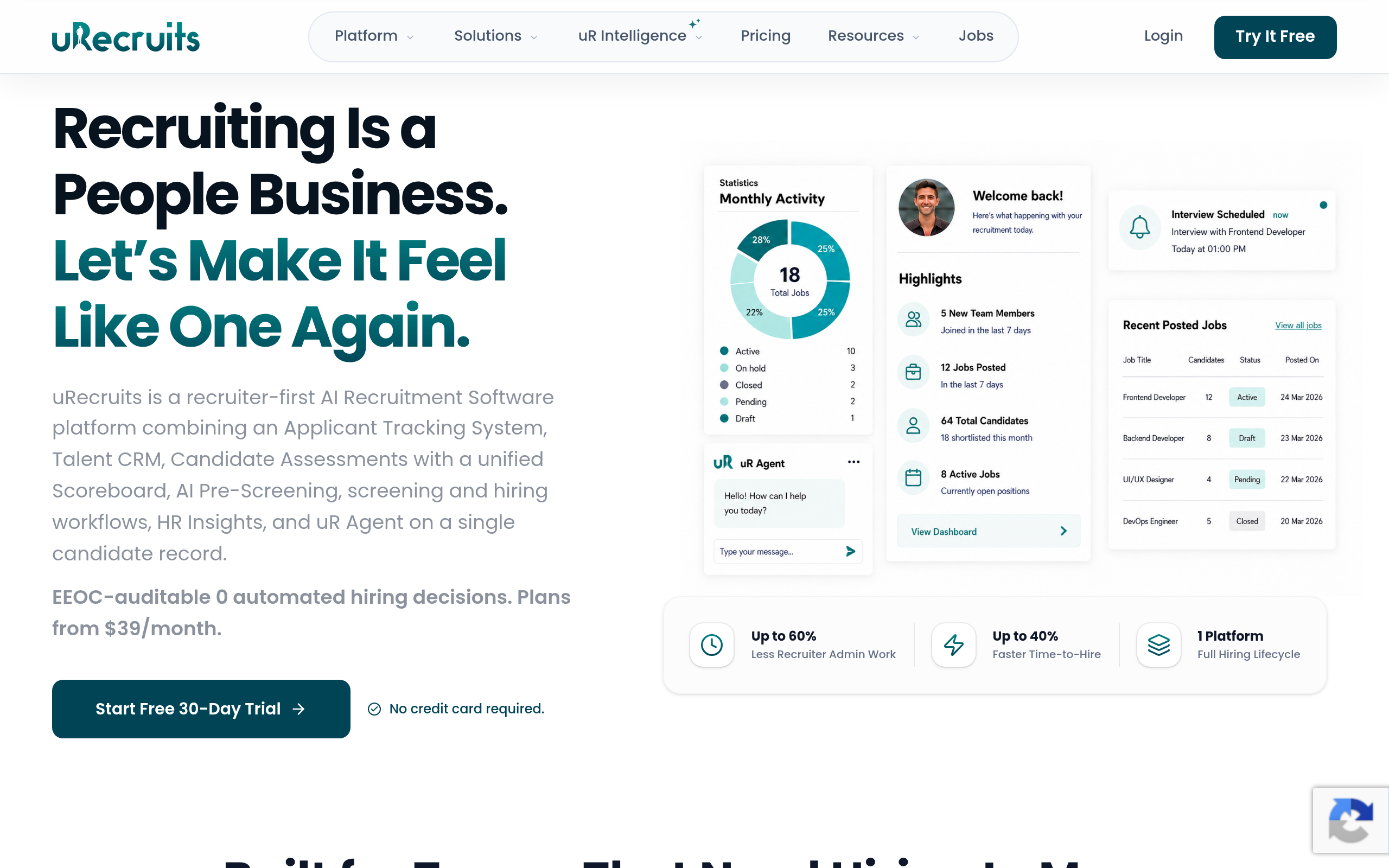
5. uRecruits — Best for Small Teams and Agencies
uRecruits is a lean AI recruiting platform designed for small agencies and startups that do not need enterprise feature depth. It covers the sourcing funnel essentials: job posting, AI-assisted candidate matching, basic outreach, and pipeline tracking. The interface is deliberately simple — setup is fast, and AI suggestions surface relevant profiles without complex configuration. If Workable feels like overkill for your hiring volume, uRecruits is the right size.
Best for: Recruiting agencies managing a small client roster, or startups doing fewer than 30 hires per year who want AI assistance without the overhead of an enterprise platform.
6. Mokka — Best for HR Generalists
Mokka sits at the intersection of HR ops and recruiting. Beyond sourcing, it handles onboarding, employee records, and people analytics — so both sourcing activity and post-hire data live in one system. The AI features assist with job description drafting and initial applicant matching. For HR generalists who own both recruiting and broader people operations, a single platform reduces the context-switching and data-transfer friction that comes from running separate tools for each function.
Best for: HR teams at small-to-mid companies where recruiting is one part of a broader people operations mandate, not a standalone department.
7. Jobright — Best for Niche and Technical Roles
Jobright applies AI to job matching and candidate discovery. On the recruiter side, its matching engine goes beyond keyword matching: it considers experience trajectory, skill adjacency, and role-fit signals that standard job board search misses. This makes it particularly useful for specialized technical or niche roles where a keyword search on a general board returns too many irrelevant results and too few strong ones.
Best for: Hiring managers and recruiters filling niche, technical, or hybrid roles where standard job board searches return low signal-to-noise.
8. AIHR Screen — Best for Source-to-First-Filter Pipelines
AIHR Screen, from the AIHR HR training and tools platform, handles both sourcing criteria setup and initial candidate ranking in a single flow. Rather than sourcing in one tool and then duplicating data into a screening tool, AIHR Screen lets you define fit criteria, rank inbound applications against them, and move qualified candidates forward — eliminating the sourcing-to-screening handoff that often creates candidate drop-off.
Best for: HR teams that want sourcing and first-stage filtering handled together without managing two separate platforms or manually exporting data between them.
How Do These Tools Compare on Core Sourcing Features?
| Tool | Multi-board Job Posting | Candidate Search / Discovery | Outreach Automation | Talent Pool / CRM | ATS Integration |
|---|---|---|---|---|---|
| Workable Agent | Yes | Yes — AI-powered | Built-in (partial) | Yes | Native (built-in ATS) |
| recruitRyte | No | No — outreach-focused | Yes — core feature | Basic | Via integrations |
| Talentpilot | No | Partial | Yes — nurture sequences | Yes — core feature | Via integrations |
| Bardeen | No | Yes — LinkedIn scraping | Partial — via playbooks | No (push to external) | Via playbooks |
| uRecruits | Yes | Yes | Basic | Basic | Partial |
| Mokka | Partial | Partial | Basic | Partial | Native (HR suite) |
| Jobright | No | Yes — AI matching engine | No | Basic | Via integrations |
| AIHR Screen | No | Partial | No | No | Partial |
Which AI Sourcing Tool Fits Your Team Size and Budget?
| Tool | Pricing Model | Free Option | Ideal Team Size | Budget Tier |
|---|---|---|---|---|
| Workable Agent | Per-job or subscription | Trial | 10–500+ employees | Mid-range |
| recruitRyte | Usage-based / subscription | Free tier | 1–50 recruiters | Low to mid |
| Talentpilot | Subscription | Free tier | 5–200 employees | Low to mid |
| Bardeen | Freemium — credits-based | Yes — generous | Any | Free for basic use |
| uRecruits | Subscription | Free tier | 1–30 employees | Low |
| Mokka | Subscription per seat / employee | Free tier | 10–300 employees | Low to mid |
| Jobright | Freemium | Yes | Any | Low |
| AIHR Screen | Subscription | Free tier | 5–100 employees | Low to mid |
How Do You Build an Effective AI Sourcing Workflow?
The most common mistake is buying one tool and expecting it to handle sourcing end-to-end. Effective AI sourcing typically involves three distinct stages, and the best tool for each stage is often different:
- Stage 1 — Discovery: Find profiles through job boards, LinkedIn, GitHub, or professional communities. Workable Agent, Jobright, and Bardeen are strongest here. Bardeen is especially practical for custom LinkedIn searches on a tight budget — it effectively replaces a LinkedIn Recruiter subscription for many teams.
- Stage 2 — Outreach: Contact candidates with personalized messages that earn responses. Generic "I came across your profile" messages get ignored at scale. recruitRyte and Talentpilot generate personalized outreach based on role requirements and candidate signals, which meaningfully improves reply rates without manual writing for each message.
- Stage 3 — Pipeline management: Track who is interested, who is mid-conversation, and who to revisit in three months. Workable Agent, uRecruits, and Mokka handle this well. If you use a separate ATS, make sure your sourcing tools push data there automatically — manual export is where candidate information gets lost.
A practical starting stack for small teams: Bardeen (free) for LinkedIn discovery, recruitRyte for outreach sequences, and any ATS for tracking. This covers 80% of sourcing needs at very low cost and proves whether AI sourcing saves your team real time before you invest in a full platform.
For teams doing 50+ hires per year, a platform like Workable Agent or uRecruits simplifies the stack and reduces the data gaps that come from stitching together separate tools.
Comparee's Verdict: Best AI Recruiting Tool for Each Use Case
Comparee's verdict on AI recruiting and sourcing tools — no hedging, just the clearest recommendation for each situation:
| Use Case | Best Tool | Why It Wins |
|---|---|---|
| Growing team that wants one sourcing platform | Workable Agent | Job distribution + AI search + ATS in one reduces tool sprawl and data gaps |
| High-volume outreach (100+ messages per week) | recruitRyte | Built specifically for recruiter outreach sequences — not adapted from sales tools |
| Building a passive candidate pipeline | Talentpilot | CRM-style nurturing designed for candidates, not generic contacts |
| LinkedIn sourcing on a budget | Bardeen | Free tier is genuinely functional; playbooks replace expensive sourcing tools |
| Small agency or startup (under 30 hires/year) | uRecruits | Lightweight, affordable, AI-assisted without enterprise complexity |
| HR generalist managing full people ops | Mokka | Recruiting inside a broader HR suite eliminates context-switching |
| Technical or niche role hiring | Jobright | Matching engine surfaces better-fit profiles than keyword-based job board search |
| Source-to-first-filter without multiple tools | AIHR Screen | Handles sourcing criteria and initial ranking together, removing the handoff gap |
If you are unsure where to start: run Bardeen for one week of LinkedIn sourcing at zero cost. If it saves you meaningful time, add recruitRyte for outreach. Most teams find this two-tool combination handles 90% of their sourcing workflow before they need a full platform investment.
Tools mentioned in this guide
Pricing, features and model availability can change over time. Always verify current details on each tool's official website before deciding.
Frequently Asked Questions
What is the best AI tool for recruiting and candidate sourcing?
What is the best AI tool for recruiting and candidate sourcing?
How does AI candidate sourcing actually work?
How does AI candidate sourcing actually work?
What is the difference between AI recruiting tools for sourcing versus screening?
What is the difference between AI recruiting tools for sourcing versus screening?
Can AI tools find passive candidates who are not actively job-hunting?
Can AI tools find passive candidates who are not actively job-hunting?
Do AI recruiting tools replace human recruiters?
Do AI recruiting tools replace human recruiters?
How much do AI recruiting and sourcing tools cost?
How much do AI recruiting and sourcing tools cost?
What is the best free AI tool for candidate sourcing?
What is the best free AI tool for candidate sourcing?
Is AI candidate sourcing compliant with EEOC and GDPR hiring regulations?
Is AI candidate sourcing compliant with EEOC and GDPR hiring regulations?
Don't just pick a tool — get the whole workflow
Tell Comparee your goal and get a complete step-by-step AI workflow with the right tool for every step.