Best AI Chatbot Builders for Businesses in 2026
Compare the best AI chatbot builders for businesses in 2026: BotSaaS, Glean, Virtualworkforce.ai, and more. Pricing, integrations, team features reviewed.
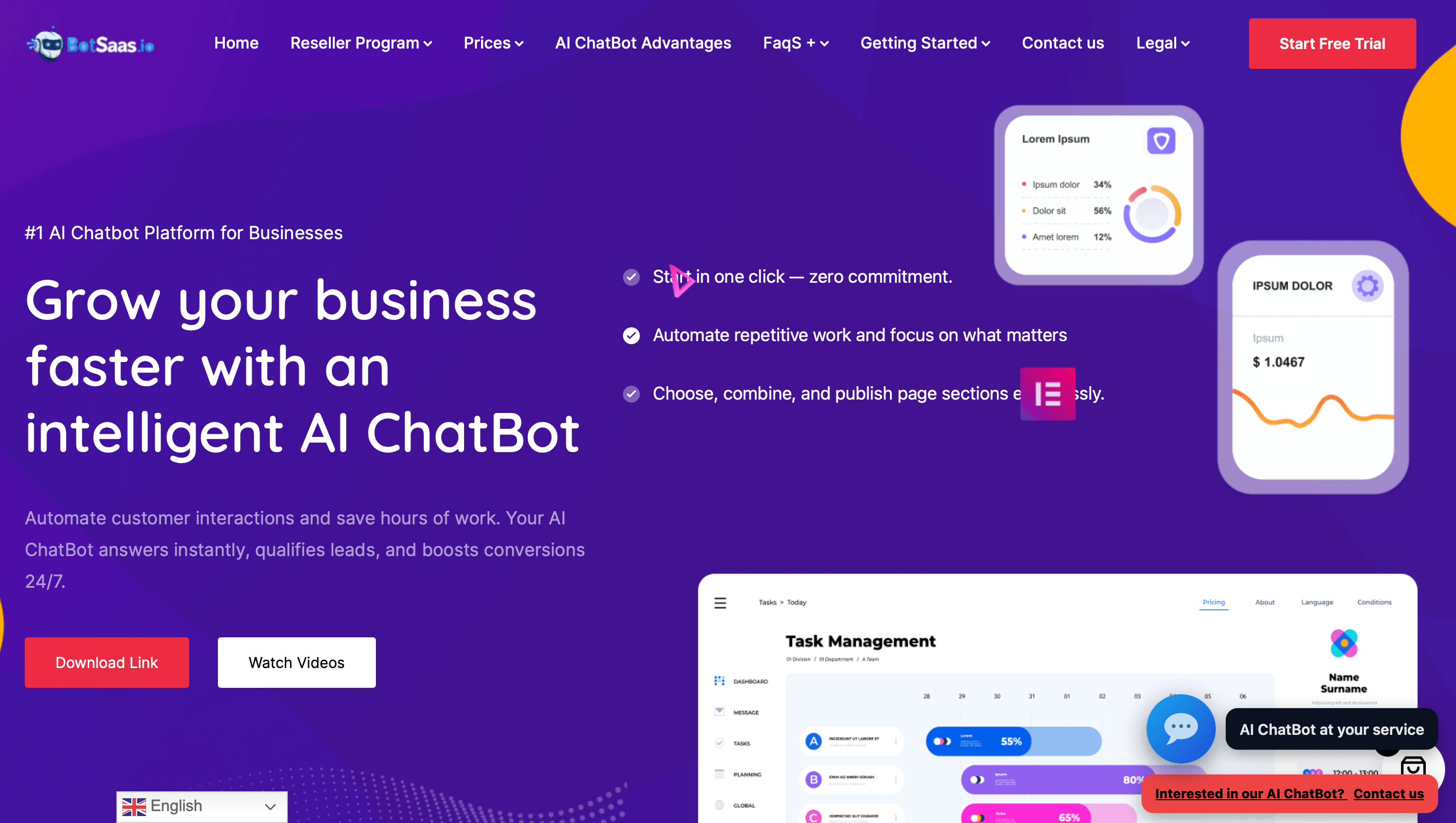
- BotSaaS is the best overall pick for small and mid-sized businesses that need a no-code chatbot deployed fast — its free tier is genuinely useful, not just a demo.
- Glean is the standout choice for enterprise teams that want AI to surface answers from internal knowledge bases (Confluence, Drive, Slack, Jira) through a conversational interface.
- Virtualworkforce.ai suits businesses that think beyond a single chat widget — it deploys coordinated AI agents across customer service, sales follow-up, and operational workflows.
- Integration depth is the most under-evaluated factor: native CRM and help-desk connectors beat webhook-only approaches in every real-world deployment.
- Most platforms have a free tier — validate your use case there before committing. Usage-based pricing can surprise you when campaign traffic spikes; model your monthly conversation volume first.
- Team features (role-based access, shared conversation history, human handoff with context) matter far more at 10+ users than they appear to during a solo trial.
Choosing the right AI chatbot builder for your business in 2026 is less about picking the flashiest demo and more about matching platform architecture to your actual workflow. The market has matured considerably: the gap between enterprise-grade and SMB-oriented platforms has narrowed, but the differences in pricing structure, integration depth, and deployment flexibility still define whether a platform works for your team or becomes shelfware six months after sign-up.
This guide is a buyer's guide — not a how-to tutorial. We cover which platform to buy for your business based on company size, technical resources, and use case. We reviewed the leading platforms listed in Comparee's AI Chatbots & Assistants directory, compared them on the dimensions that matter in a real procurement decision, and give concrete verdicts — not hedged "it depends" non-answers.
What Is the Best AI Chatbot Builder for Business in 2026?
The direct answer: BotSaaS is the best choice for most small-to-mid-sized businesses that want to move fast without engineering resources. Glean wins for enterprise teams that need AI woven into internal knowledge infrastructure. Virtualworkforce.ai is the right pick when your ambitions stretch beyond a single chat widget into multi-agent business automation.
Here is the quick verdict matrix — bookmark this if you only have two minutes:
| Tool | Best For | Free Tier | Pricing Model | Technical Skill Needed |
|---|---|---|---|---|
| BotSaaS | SMBs, fast no-code deployment | Yes | Tiered SaaS subscription | Low — no-code builder |
| Glean | Enterprise internal knowledge AI | Yes (limited) | Enterprise contract / usage | Medium — IT-led setup |
| Virtualworkforce.ai | Multi-agent workflow automation | Yes | Seats + usage hybrid | Medium |
| AI DevKit | Developer teams, custom builds | Yes | Usage-based / API | High — developer tool |
| ChatChit AI | Conversational commerce, engagement | Yes | Tiered subscription | Low |
| AI Chat | Budget-conscious teams, basic FAQ bots | Yes | Freemium / pay-as-you-go | Low |
What Features Should You Look for in a Business Chatbot Builder?
Before you open a single demo tab, define what your chatbot actually needs to do. The six dimensions below separate platforms that deliver business value from those that look impressive in a trial and frustrate in production:
- Natural language understanding quality: Can the bot handle paraphrasing, typos, and multi-intent messages — or does it fall back to "I didn't understand that" every third message? Test with real customer queries from your support inbox, not curated demos.
- Integration depth: Native connectors to your CRM (HubSpot, Salesforce), help desk (Zendesk, Freshdesk), or e-commerce platform (Shopify) are worth far more than a generic webhook. Every manual data sync is a failure point.
- Team and role management: As soon as more than two people manage the bot — customer success, product, marketing — you need role-based access control, shared conversation views, and audit logs. Most platforms bolt these on as afterthoughts in lower tiers.
- Multi-channel deployment: Website widget is table stakes. Does the platform also cover WhatsApp, Facebook Messenger, SMS, and email — without requiring separate builds for each channel?
- Analytics and containment reporting: Conversation volume, containment rate (queries resolved without human intervention), fallback frequency, and customer satisfaction scores should be native and exportable — not requiring a separate BI tool.
- Human escalation handling: A bot that cannot hand off to a live agent with the full conversation context is a liability in any customer-facing deployment. Check how escalation works before you sign up, not after.
The Best AI Chatbot Builders for Businesses, Reviewed
BotSaaS — Best for SMBs That Need to Launch in Days
BotSaaS is purpose-built for businesses that want a production-ready chatbot without writing a line of code or waiting three months for an IT project. Its visual flow builder lets customer success and marketing staff design conversation logic, connect to knowledge bases, and publish to a website widget without engineering involvement.
The free tier is substantive enough to run a real pilot — not just a restricted sandbox. You can design full conversation flows, handle a meaningful volume of monthly conversations, and get basic analytics to demonstrate ROI before committing to a paid plan. Paid tiers unlock higher conversation limits, advanced integrations, and team management features that matter once more than one person owns the bot.
Where BotSaaS shows its limits: very large organisations with complex data governance requirements will find its enterprise features thinner than dedicated enterprise platforms. And deep custom integrations beyond the pre-built connector library require either their API or a middleware layer. For the majority of SMBs, though, those are not blockers.
Comparee's verdict: BotSaaS is the safest default choice for any business with fewer than 200 employees that wants a chatbot live quickly without an engineering sprint.
Glean — Best for Enterprise Internal Knowledge and AI Search
Glean occupies a distinct position in this market: it is less a traditional chatbot builder and more an AI knowledge layer that surfaces answers from your organisation's existing data through a conversational interface. Connect it to Confluence, Google Drive, Slack, Jira, Salesforce, and dozens of other internal systems, and it builds a unified knowledge graph that employees can query in plain language.
The security model is genuinely enterprise-grade: Glean respects the permissions already set on source systems, so an employee asking about a confidential HR document will not see information they are not authorised to access. This is a real differentiator — most platforms require you to re-configure access control at the chatbot layer, which creates maintenance overhead and risk.
For external customer-facing use cases, Glean is more than you need and harder to justify on cost. Its sweet spot is the internal employee helpdesk: IT support tickets, HR policy questions, onboarding FAQs, and knowledge retrieval for sales and customer success teams. Enterprise pricing and a heavier IT-led deployment mean it is not appropriate for businesses under 100 seats.
Comparee's verdict: Glean is the right enterprise purchase when internal knowledge retrieval — not external customer chat — is the primary use case.
Virtualworkforce.ai — Best for Multi-Agent Automation Beyond a Simple Widget
Virtualworkforce.ai reframes what a chatbot builder can be. Instead of a single conversational widget, it enables businesses to deploy networks of AI agents — each assigned a specific role — that coordinate across customer service, sales follow-up, appointment scheduling, and back-office workflows through a unified management dashboard.
A typical deployment might involve a front-line customer service agent that handles initial queries, an escalation agent that gathers structured information for complex cases, and a follow-up agent that sends post-interaction surveys and retention offers. Each is manageable separately but operates as a coordinated system. The platform's monitoring tools let operations teams track agent performance, conversation quality, and workflow completion rates.
The trade-off is setup time. Virtualworkforce.ai requires more planning and configuration than a no-code point-and-click builder. Teams that treat it like BotSaaS and expect to be live in 48 hours will be disappointed. Teams that invest in mapping their automation workflows first will find it significantly more capable than any single-agent platform.
Comparee's verdict: Virtualworkforce.ai is the right choice for mid-market and scaling businesses that want to automate across multiple customer and operational touchpoints — not just answer FAQ queries.
AI DevKit — Best for Developer Teams with Custom Requirements
AI DevKit targets engineering teams that have hit the ceiling of visual builders. It provides APIs, SDKs, and pre-built AI components that developers assemble into production-grade conversational systems with full control over conversation logic, response generation, and deployment architecture — cloud, on-premise, or embedded in a mobile application.
The advantage is genuine flexibility. Custom model integration, bespoke conversation flow logic, complex backend API orchestration — all of these are straightforward when you own the code. The disadvantage is that every hour of flexibility is an hour of engineering cost. Non-technical teams should not evaluate AI DevKit; it is a developer tool, not a business user platform.
Comparee's verdict: Use AI DevKit if your engineering team has specific chatbot requirements that no off-the-shelf builder satisfies, and if you have the developer capacity to build and maintain it.
ChatChit AI — Best for Conversational Commerce and Marketing Engagement
ChatChit AI is oriented toward conversion and engagement — helping businesses use AI-driven conversation to guide users through a purchase journey, qualify inbound leads, or handle post-sale support. The setup process is streamlined for non-technical users, and the pre-built templates cover common e-commerce and service business scenarios out of the box.
It is not the deepest platform on integrations or analytics depth, but it delivers a clean user experience without requiring a technical team. For e-commerce brands or service businesses that want to add a conversational layer to their marketing funnel without an IT project, ChatChit AI offers an accessible, budget-proportionate path.
Comparee's verdict: ChatChit AI is the right pick for e-commerce and digital service businesses prioritising marketing funnel automation and lead capture over deep customer support workflows.
AI Chat — Best for Budget-Conscious Teams with a Narrow Scope
AI Chat serves the segment that needs something functional and affordable without the complexity of a full chatbot builder platform. It handles FAQ deflection, basic lead capture, and simple routing to human agents — nothing more, nothing less. The free tier is genuinely useful for a scope this narrow, and the pay-as-you-go pricing model means you are not locked into a monthly commitment before you have proven the value.
The ceiling is low: complex conversation flows, deep integrations, and advanced team management are not this platform's strengths. But for businesses where the chatbot scope is genuinely narrow — answering 15 to 20 common questions and routing everything else to email — AI Chat delivers without overcomplicating the procurement decision.
Comparee's verdict: AI Chat is the right starting point for very small businesses or teams running a narrow proof-of-concept before investing in a more capable platform.
How Do These Platforms Compare on Core Features?
| Feature | BotSaaS | Glean | Virtualworkforce.ai | AI DevKit | ChatChit AI | AI Chat |
|---|---|---|---|---|---|---|
| No-code visual builder | Yes | Partial | Partial | No | Yes | Yes |
| Multi-channel deployment | Yes | Partial | Yes | Yes (via API) | Partial | Limited |
| Human handoff with context | Yes | Yes | Yes | Custom build | Partial | Basic |
| Native CRM integration | Yes | Yes (deep) | Yes | Custom build | Limited | No |
| Role-based team management | Yes | Yes | Yes | Custom build | Basic | No |
| Analytics and containment reporting | Yes | Yes | Yes | Custom build | Basic | Basic |
| Enterprise security / SSO | Higher tiers | Yes (native) | Yes | Custom build | No | No |
| Free tier available | Yes | Yes (limited) | Yes | Yes | Yes | Yes |
What Will You Actually Pay? Pricing Models Explained
AI chatbot builder pricing in 2026 follows four dominant models. Understanding the structure before signing up is the difference between a predictable software line item and an unpleasant finance conversation when conversation volume spikes:
| Pricing Model | How It Works | Best For | Watch Out For |
|---|---|---|---|
| Tiered SaaS subscription | Flat monthly or annual fee per plan tier, with limits on conversation volume or active seats | Businesses with predictable, stable conversation volumes and clear budget ownership | Overage charges when you exceed the tier limit; sudden campaign spikes can trigger a forced tier upgrade mid-billing cycle |
| Usage-based / pay-as-you-go | Charged per conversation, message, or API call at a set rate | Early-stage businesses with unpredictable volume; developer builds with variable traffic | Month-end bills that are hard to forecast; requires monitoring to avoid runaway costs during promotions |
| Enterprise annual contract | Custom pricing negotiated annually; typically includes a conversation or seat commitment, dedicated support, and SLA guarantees | Large organisations with compliance requirements, dedicated IT support needs, and multi-team deployments | Long lock-in periods; significant procurement process; price discovery requires a sales call |
| Seats + usage hybrid | Per-seat fee for the team accessing the platform, plus a consumption charge for AI processing volume | Growing businesses deploying multiple agents across teams; mid-market with variable AI workloads | Cost can scale non-linearly as both team size and usage grow simultaneously |
One practical rule: estimate your expected monthly conversation volume — then price it at the next tier up from your current estimate. Growth and seasonal campaigns rarely stay at baseline. Locking into the minimum tier and hitting overages consistently costs more than starting at the right tier from the beginning.
Which AI Chatbot Builder Is Right for Your Business Size?
| Business Profile | Recommended Platform | Why It Fits |
|---|---|---|
| Solo founder / micro-business (<5 employees) | AI Chat or ChatChit AI | Minimal setup overhead, free tiers cover narrow use cases, no IT resources required |
| Small business (5–50 employees) | BotSaaS | No-code builder, real team features, reasonable paid tier pricing, fast deployment |
| Mid-market (50–500 employees) | Virtualworkforce.ai or BotSaaS (advanced tier) | Multi-channel support, team collaboration, workflow automation across departments |
| Enterprise (500+ employees) | Glean | Deep integrations, permission-aware knowledge retrieval, enterprise security and compliance |
| Product or engineering team | AI DevKit | Full API and SDK control, custom model integration, flexible deployment architecture |
Comparee's Verdict: Which AI Chatbot Builder Should Your Business Buy?
After reviewing these platforms against real business requirements, here are our concrete, non-hedged recommendations:
Buy BotSaaS if you run an SMB without a dedicated developer and you need a chatbot live within the week. Start on the free tier, run a 30-day pilot, then upgrade to the paid plan once you have proven the use case. It is the lowest-risk entry point for this category.
Buy Glean if your organisation has a genuine internal knowledge problem — employees spending hours hunting answers across Confluence, Slack, and shared drives — and you have the IT capacity for a proper deployment. The setup investment pays off quickly at scale, and the permission model is genuinely enterprise-safe.
Buy Virtualworkforce.ai if your chatbot strategy involves more than one workflow touchpoint. If you need a customer service agent, a sales follow-up agent, and an appointment management agent to coordinate — rather than three separate point solutions — this is the platform that handles that architecture cleanly.
Use AI DevKit if your engineering team has requirements that no visual builder satisfies. Full model control, bespoke conversation logic, and custom deployment environments are where this platform earns its place. Do not evaluate it without engineering capacity to support it.
Start with ChatChit AI or AI Chat if budget is tight and your chatbot scope is narrow — FAQ deflection, lead capture, basic routing. Both offer real free tiers, neither requires a long procurement process, and either can serve as a bridge while you build the internal case for a more capable platform.
For a broader view of the AI chatbot landscape — including tools across customer support, sales automation, and internal knowledge — see the full AI Chatbots & Assistants category on Comparee.
Tools mentioned in this guide
Pricing, features and model availability can change over time. Always verify current details on each tool's official website before deciding.
Frequently Asked Questions
What is the best AI chatbot builder for small businesses in 2026?
What is the best AI chatbot builder for small businesses in 2026?
How much does an AI chatbot builder typically cost for a business?
How much does an AI chatbot builder typically cost for a business?
Can I build an AI chatbot for my business without coding?
Can I build an AI chatbot for my business without coding?
What integrations should a business chatbot builder support?
What integrations should a business chatbot builder support?
What is the difference between a chatbot builder and a chatbot platform?
What is the difference between a chatbot builder and a chatbot platform?
How long does it take to set up a business chatbot?
How long does it take to set up a business chatbot?
Which AI chatbot builder is best for e-commerce businesses?
Which AI chatbot builder is best for e-commerce businesses?
Is Glean a chatbot builder for customer-facing use cases?
Is Glean a chatbot builder for customer-facing use cases?
Don't just pick a tool — get the whole workflow
Tell Comparee your goal and get a complete step-by-step AI workflow with the right tool for every step.