OPEN DUCK MINI: A DIY BDX-STYLE DROID THAT LEARNS TO WALK
A tiny two-legged Disney-BDX-style droid that learns to walk with reinforcement learning — Google and NVIDIA both used it for demos.
by Antoine Pirrone & Grégoire Passault (Rhoban)
RoboticsAI
- difficulty
- ●●●●○
- time
- several weekends
- license
- MIT
- repo
- repo ACTIVE900 stars
●●●●○ · several weekends · MIT · 900 stars · repo ACTIVE
WHAT YOU’LL NEED
- 3D printer + filament — printable parts — files are in the repo
- Electronic parts — full list with part numbers in the repo BOM
- Dev board / microcontroller — runs the project firmware
- Soldering kit + basic tools — one-time buy, serves every future build
Partner
COMPAREE VERDICT
This one is catnip for the AI-robotics crowd: a palm-sized, Disney-BDX-style two-legged droid that doesn't just walk from hand-tuned code — it learns to walk in simulation and transfers that to the real robot (sim-to-real reinforcement learning). It's credible enough that Google and NVIDIA both featured it in their own demos. The repo genuinely ships CAD, a BOM, runtime code, and a trained walking policy. The honest catch, straight from the creator: this is a 'working repo' with undocumented scripts and an assembly guide that isn't finished — so it's for tinkerers who are comfortable filling gaps, not a click-together kit. If that's you, it's one of the coolest small robots you can build.
IN THE REPO
NOT IN THE REPO
- —Default branch is 'v2' (bipedal); 'main' is the older v1
- —Repo includes CAD/STL, a BOM, runtime code, and a trained walking policy (ONNX)
- —The creator is candid: it's a 'working repo' with undocumented scripts and an incomplete assembly guide
- —URDF/MJCF are generated from OnShape
Can I build this?
Build at your own risk. Projects involve tools, electronics and sometimes mains voltage — follow the creator’s safety notes.
 Partner · Kickstarter
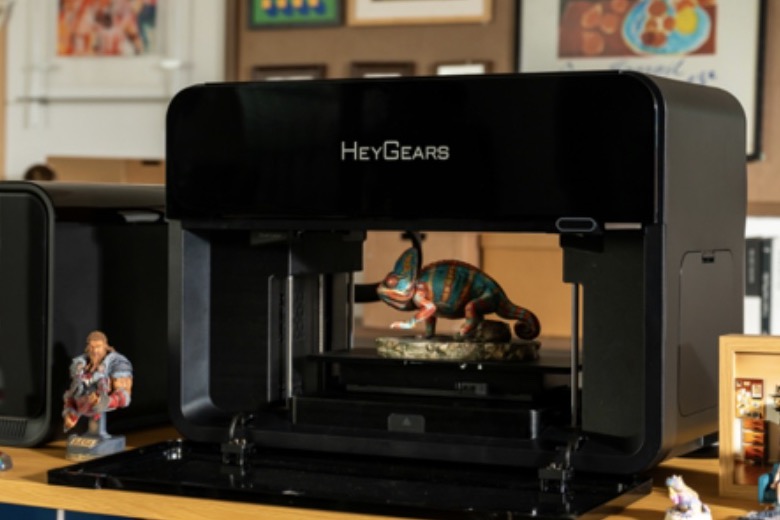
HeyGears G1: 10M+ colors and transparent parts in one print, plus UV printing on flat objects. Figures, parts and labels — no painting.
Videos
Apérobot: Open Duck Mini V2 (meetup talk)
The creator has no personal YouTube channel — the primary demos are mp4s embedded in the v2 README (sim2real walking, RL, imitation learning).
Start here
Navigation into the creator’s own docs — we don’t rewrite the guide, we route you to the source.
- 1.Read the build guide (the most complete write-up)
- 2.Read the v2 repo (note the branch) (default branch is v2)
- 3.Open the CAD (OnShape-derived; STL in repo)
- 4.Look at the RL runtime (walking policy + runtime)
- 5.Join the Discord (where the gaps get filled)
Resources
Documentation, files and community threads for this build — we link straight to the original sources and never rehost the creator’s files.
 Partner · Kickstarter
CORE POWER BANK S: 0.2" thin, 2.8 oz, 5000 mAh with 22.5W fast charging. Semi-solid battery, carbon fiber, IPX7 waterproof.
KNOWN ISSUES
- The default branch is 'v2' — 'main' is the old v1; make sure you're on the right one
- The creator openly warns of undocumented scripts and an incomplete assembly guide — plan for detective work
- README build images use expiring GitHub attachment links — save your own copies if you reference them
- It's bipedal (two legs), not a quadruped — balance is the hard part
Does it really learn to walk?
Yes — it uses sim-to-real reinforcement learning: the gait is trained in simulation (imitation learning plus RL) and transferred to the real robot, and a trained policy ships in the repo.
Why did Google and NVIDIA use it?
It's a compact, open, credible BDX-style platform, so it's handy for showcasing their own robotics/AI tooling.
Is it beginner-friendly?
No. The creator calls it a working repo with undocumented parts. It's a great project if you like filling in gaps; frustrating if you want a finished kit.
What does it cost?
Band $$ — the servos dominate. The BOM has current prices.
Community builds
No community builds yet — be the first, we feature the best ones.
Discussion1
FROM THE COMPAREE TEAM
The creator openly calls this a 'working repo' with undocumented scripts and an unfinished assembly guide. Do you enjoy detective-work builds, or is candor no substitute for docs?
Stanford Doggo: The Open-Source Robot Dog That Backflips
●●●●○ · a legged robot with a stronger paper trail, but sparser files
SpotMicro: Print Your Own Spot-Style Robot Dog
●●●●○ · a four-legged alternative that's more of a known build
XLeRobot: A Household Robot on an IKEA Cart
●●●●○ · if you'd rather have arms than legs
Antoine Pirrone & Grégoire Passault (Rhoban)
Bordeaux robotics researchers building an open BDX-style droid that learns to walk. Sponsored by HuggingFace and Pollen Robotics; candid about the repo being a work in progress.
Keep building — related projects
Same category, picked by how close they are to this build.
 FULL CAD
3D print this robot arm, show it a task once, and it learns to repeat it
RoboticsAI●●●●○advanced
 FULL CAD
SO-ARM100: The Low-Cost Robot Arm Behind HuggingFace LeRobot
RoboticsAI●●●○○moderate

 FULL CAD
XLeRobot: A Household Robot on an IKEA Cart
RoboticsAI●●●●○advanced
 FULL CAD
You can 3D-print your own walking Star Wars BD-X droid - fully open-source
RoboticsAI●●●●●expert
DISCLAIMER
- Comparee is not the author of the projects featured here. All rights to each project belong to its creator — every page links to the original source, and we never host creators’ files.
- Information is provided without warranty and may become outdated as projects evolve. Prices are indicative bands only — always check the creator’s parts list for current costs.
- Building and operating any project is at your own responsibility. Protective equipment, safe workshop practice and compliance with local regulations are the builder’s responsibility.
CompareeTEAM1mo ago
A credibility marker we found interesting: both Google and NVIDIA have used this little BDX-style droid in official demos — Google's Gemma playground and NVIDIA's Newton physics showcase. Practical warnings from our read: the real code is on the 'v2' branch, not 'main', and the README's build photos use expiring GitHub attachment links, so save copies. Anyone gotten the RL gait running on real hardware?