AI for Finance & Accounting: The Complete Guide for 2026
AI for finance and accounting in 2026 — automate bookkeeping, reporting, forecasting and analysis, plus accuracy and compliance caveats and the best tools.
Key takeaways
- AI for finance and accounting automates the slow, manual work — bookkeeping, reconciliation, reporting and forecasting — so finance teams spend more time on analysis and decisions.
- It does not replace accountants or remove the need for human review and compliance — it speeds up the routine and surfaces insight faster.
- Best tools: Zeni for AI bookkeeping, ScaleXP for automated reporting and forecasting, Holistics for financial BI, Coupler.io and Coefficient for live financial data.
- Always keep a human in the loop — review AI output, and respect accounting standards, audit trails and regulatory compliance.
- Use AI for speed and visibility; keep judgement, sign-off and accountability human.
AI for finance and accounting uses AI to automate the slow, repetitive work of the finance function — categorising transactions, reconciling accounts, generating reports and building forecasts — so finance teams spend far less time on data entry and far more on analysis, planning and decisions. Finance has always carried a heavy manual burden: closing the books, chasing reconciliations, assembling reports from scattered sources. AI compresses much of that work, but it does so within firm limits — accuracy, human review and compliance are non-negotiable in a domain where mistakes have real consequences. This guide covers what AI can do in finance, where it genuinely helps, the caveats you must respect, and the best tools in 2026.
What is AI for finance and accounting?
AI for finance and accounting is the use of machine learning and automation to handle tasks that finance and accounting teams have traditionally done by hand. That includes categorising and coding transactions, reconciling bank and ledger entries, flagging anomalies, pulling data from invoices and receipts, generating recurring reports, and producing forecasts from historical patterns. The point is not to remove accountants from the equation — it is to remove the drudgery. By taking over the repetitive, rules-based work that consumes most of a finance team's hours, AI frees skilled people to do the things only they can: interpret the numbers, advise the business, and make judgement calls. It turns finance from a backward-looking, data-entry-heavy function into a faster, more forward-looking one.
Where AI genuinely helps in finance
The value shows up across several concrete areas. Bookkeeping automation — categorising transactions, matching receipts, and keeping the ledger current with far less manual effort. Reconciliation — matching transactions across accounts and flagging mismatches automatically. Reporting — assembling recurring management reports and dashboards from live data instead of rebuilding spreadsheets each month. Forecasting — projecting cash flow, revenue and expenses from historical patterns. And financial analysis — surfacing trends, variances and anomalies a person might miss in a sea of rows. The common thread is speed and visibility: AI gets accurate, up-to-date numbers in front of decision-makers faster, so finance can spot problems and opportunities while there is still time to act on them.
Best AI finance and accounting tools in 2026
| Need | Best tool |
|---|---|
| AI bookkeeping & finance ops | Zeni |
| Automated reporting & forecasting | ScaleXP |
| Financial BI & dashboards | Holistics |
| Live financial data into sheets/reports | Coupler.io, Coefficient |
For AI-driven bookkeeping and finance operations, Zeni combines automated bookkeeping with finance dashboards so the books stay current with minimal manual work. For automated reporting and forecasting, ScaleXP pulls financial data together and produces management reports and forecasts. For financial business intelligence and dashboards, Holistics turns your financial data into explorable reports and metrics. And to get live financial data into spreadsheets and reports, Coupler.io and Coefficient sync data from your accounting and finance systems automatically. To go deeper on turning numbers into insight, see our guide to AI data analysis and BI.
How to adopt AI in your finance function (step by step)
- Start with the biggest time sink — usually bookkeeping or reconciliation — and automate that first with a tool like Zeni.
- Connect your data sources — accounting system, bank feeds, billing — so AI works from live, accurate data.
- Automate recurring reports with ScaleXP or Holistics instead of rebuilding spreadsheets each period.
- Add forecasting once your historical data is clean and connected.
- Keep a human review step — an accountant signs off on AI output before it drives decisions or filings.
- Document the audit trail — ensure every automated step is traceable for compliance and audit.
The accuracy and human-review caveat (read this)
This is the part that matters most in finance. AI is fast, but it is not infallible, and finance is a domain where errors carry real cost — misstated reports, wrong tax positions, bad decisions. So the rule is simple: keep a human in the loop. AI should categorise, reconcile, report and forecast, but a qualified person should review the output before it is relied upon. Treat AI forecasts as informed estimates, not guarantees — they project from the past and cannot foresee shocks. Treat automated categorisation as a strong first pass that still needs spot-checking. And never let AI output flow unchecked into financial statements, tax filings or board reports. The goal is to use AI to do the work faster and more accurately than manual effort alone, while a human retains judgement, sign-off and accountability. That combination is what makes AI safe and valuable in finance rather than risky.
Compliance, audit trails and data security
Finance is one of the most regulated functions in any business, and AI does not change the obligations — it operates inside them. Whatever you automate must still respect accounting standards, produce a clear and traceable audit trail, and meet the regulatory requirements that apply to your jurisdiction and industry. That means every AI-assisted step should be documented and reviewable, so an auditor can follow how a number was produced. It also means taking data security and confidentiality seriously: financial data is sensitive, and the tools handling it must protect it appropriately. None of this is a reason to avoid AI — it is a reason to adopt it deliberately, with controls in place. The finance teams that benefit most are the ones that pair AI's speed with rigorous governance, ensuring that faster does not come at the expense of compliant, accurate and accountable. The technology accelerates the work; the responsibility for getting it right stays with the people and the controls around it.
Why AI is reshaping the finance function
For decades, the finance function spent a disproportionate share of its time looking backwards — closing the books, reconciling accounts, assembling reports about what already happened. The skill of finance professionals was often consumed by the mechanical work of getting accurate numbers together rather than interpreting them. AI is shifting that balance fundamentally. By automating the data gathering, categorisation, reconciliation and report assembly, it collapses the time between a transaction occurring and a decision-maker seeing its implications. That changes what finance can be: instead of a monthly retrospective produced after days of manual effort, finance becomes a continuous, forward-looking partner to the business, with live dashboards and faster forecasts. The accountants and analysts are not displaced — their work moves up the value chain, from assembling data to advising on it. The teams embracing this are not just closing faster; they are giving their organisations earlier, sharper visibility into cash, performance and risk, which is exactly when financial insight is most valuable.
The bottom line
AI in finance and accounting automates the routine — bookkeeping, reconciliation, reporting and forecasting — so finance teams move faster and spend their time on analysis rather than data entry. Use Zeni for AI bookkeeping, ScaleXP for automated reporting and forecasting, Holistics for financial BI, and Coupler.io or Coefficient to feed live financial data into your reports. Just keep a human in the loop: review AI output, respect accounting standards and audit trails, and keep judgement and sign-off human. Done that way, AI makes finance faster and more insightful without compromising accuracy or compliance.
Disclaimer: AI finance and accounting tools accelerate work but are not infallible. Keep a qualified human reviewing all output, respect accounting standards, audit trails and regulatory compliance, and do not rely on AI output for financial statements, tax filings or decisions without review.
Tools mentioned in this guide
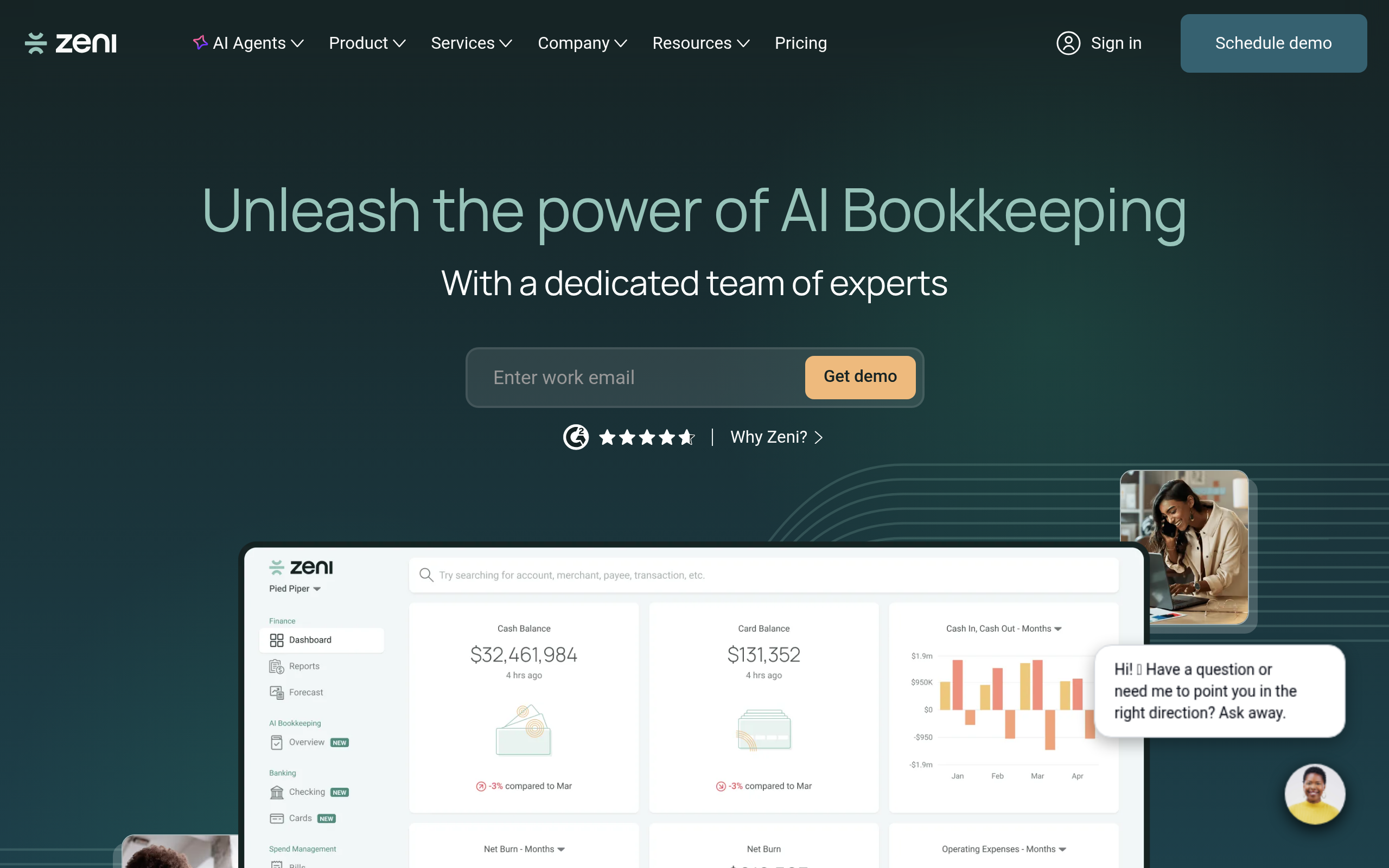
Pricing, features and model availability can change over time. Always verify current details on each tool's official website before deciding.
Frequently Asked Questions
What is AI for finance and accounting?
What is AI for finance and accounting?
What are the best AI tools for finance and accounting?
What are the best AI tools for finance and accounting?
Can AI replace accountants?
Can AI replace accountants?
Is it safe to use AI for financial reporting?
Is it safe to use AI for financial reporting?
Can AI do forecasting in finance?
Can AI do forecasting in finance?
How do I start using AI in my finance function?
How do I start using AI in my finance function?
Don't just pick a tool — get the whole workflow
Tell Comparee your goal and get a complete step-by-step AI workflow with the right tool for every step.