Best AI Tools for Threat Detection & Vulnerability Scanning in 2026
Compare top AI tools for threat detection & vulnerability scanning in 2026: Zscaler, CrowdStrike, SentinelOne, Tenable, Centraleyes — with clear verdicts by buy
- Threat detection (EDR/XDR/SIEM) and vulnerability scanning are fundamentally different disciplines — most enterprise security programs need both layers.
- Zscaler leads in zero-trust network threat prevention, inspecting all traffic — including encrypted sessions — inline with AI classification before connections are allowed.
- Centraleyes is the go-to platform for CISOs and GRC teams who need to aggregate scanner output from multiple tools into a single, boardroom-ready risk score.
- CrowdStrike Falcon and SentinelOne Singularity dominate endpoint threat detection; Microsoft Sentinel leads for cloud-native SIEM within the Microsoft ecosystem.
- Tenable.io and Qualys VMDR are the most widely deployed vulnerability management platforms at enterprise scale, both using AI to prioritize which vulnerabilities actually matter.
- AI has transformed triage and prioritization — but human analysts remain essential for context, containment decisions, and adversarial reasoning.
Picking an AI security tool in 2026 is harder than it should be, because the market lumps together two very different problems: catching active attacks and finding weaknesses before they are exploited. Buying the wrong category — or conflating the two — is one of the most expensive mistakes a security team can make. This guide separates the disciplines, compares the leading platforms in each, and tells you exactly which tool fits which buyer — no filler, no invented benchmarks.
What Is the Difference Between Threat Detection and Vulnerability Scanning?
Both disciplines protect your organization, but they operate at different points in the attack lifecycle.
Threat detection tools — Endpoint Detection and Response (EDR), Extended Detection and Response (XDR), and Security Information and Event Management (SIEM) — monitor your environment in real time. They collect process telemetry, network flows, authentication logs, and cloud API calls, then use behavioral AI and correlation rules to flag when something looks like an active intrusion. Their core question is: Is an attack happening right now?
Vulnerability scanning tools catalog every asset in your environment and compare each one against databases of known CVEs, misconfigurations, and compliance benchmarks. They answer a different question: Where are the weaknesses an attacker could exploit? They run before the attack, not during it.
| Dimension | Threat Detection (EDR / XDR / SIEM) | Vulnerability Scanning |
|---|---|---|
| Primary question | Is an attack happening now? | Where could an attack happen? |
| Data analyzed | Process telemetry, logs, network flows, cloud events | Asset inventory, CVE databases, config audits |
| AI role | Behavioral anomaly detection, alert correlation, triage automation | Risk prioritization, exploit-probability scoring, patch intelligence |
| Output | Alerts, incident timelines, MITRE ATT&CK mappings | Vulnerability reports, risk scores, remediation task lists |
| Cadence | Continuous and real-time | Scheduled scans or continuous assessment |
| Typical buyers | SOC analysts, incident responders, MSSPs | IT operations, GRC teams, CISOs |
Which AI Tools Are Best for Threat Detection in 2026?
The leading threat detection platforms share a common foundation — AI trained on massive threat telemetry datasets — but differ significantly in architecture, automation depth, and ecosystem fit.
CrowdStrike Falcon
CrowdStrike Falcon is the benchmark EDR/XDR platform for large enterprises and MSSPs. Its AI engine is trained on petabytes of global adversary activity, enabling it to detect novel malware variants, fileless attacks, and living-off-the-land techniques that signature-based tools miss entirely. The Falcon threat graph correlates endpoint, identity, and cloud telemetry into a unified incident view. CrowdStrike's Threat Intelligence service — built on active human adversary tracking — gives it an edge in named threat group attribution that few peers match.
SentinelOne Singularity
SentinelOne Singularity competes directly with CrowdStrike but leans further into autonomous response: the platform can isolate compromised hosts, roll back malicious file changes, and kill attack chains without requiring human approval at each step. Its Storyline engine chains individual process events into a complete causal attack narrative, dramatically cutting the time analysts spend reconstructing incidents. It is the strongest fit for organizations that want maximum automation and minimum analyst toil — particularly leaner security teams.
Microsoft Sentinel
Microsoft Sentinel is a cloud-native SIEM/SOAR built on Azure. Its AI-driven UEBA (User and Entity Behavior Analytics) surfaces insider threats and compromised accounts across Microsoft 365, Entra ID, Defender, and Azure in a way no third-party SIEM can replicate without expensive custom connectors. Sentinel charges per gigabyte of ingestion rather than per seat, which can be highly cost-effective for organizations already running the Microsoft security stack. The community of contributed analytic rules and workbooks is the largest in the SIEM market.
Zscaler
Zscaler approaches threat detection from the network layer using a zero-trust proxy architecture. Instead of perimeter firewalls that attackers routinely bypass, Zscaler proxies all connections — including TLS-encrypted sessions — through its global cloud, applying AI-based threat classification inline before any traffic is permitted. It excels at detecting command-and-control (C2) callbacks, DNS tunneling, and lateral movement in hybrid and cloud-first environments. Organizations migrating away from legacy VPN infrastructure will find Zscaler uniquely positioned at the intersection of network security and zero-trust access. Explore the full range of tools in the Cybersecurity category on Comparee.
Which AI Tools Are Best for Vulnerability Scanning in 2026?
Modern vulnerability management has evolved far beyond running periodic scans against an IP range. Today's platforms combine continuous asset discovery, AI-driven risk prioritization, and patch orchestration into an integrated lifecycle.
Tenable.io / Tenable One
Tenable.io — now part of the broader Tenable One exposure management platform — is one of the most widely deployed vulnerability management solutions globally. Its Predictive Prioritization feature uses machine learning to cross-reference raw CVE severity scores with real-world exploit availability and weaponization probability. The result: teams focus remediation effort on the vulnerabilities attackers are actually using, not just those with the highest CVSS score. Tenable One extends coverage to cloud infrastructure, OT/ICS environments, web applications, and container images from a single platform.
Qualys VMDR
Qualys VMDR (Vulnerability Management, Detection and Response) is a cloud-native platform that combines asset discovery, vulnerability scanning, TruRisk business-context scoring, and automated patch orchestration in a single agent-based deployment. Its compliance reporting covers hundreds of regulatory frameworks out of the box. Qualys suits security teams that want an all-in-one vulnerability lifecycle platform with strong audit-ready reporting and minimal operational overhead.
Rapid7 InsightVM
Rapid7 InsightVM offers live vulnerability monitoring — not just point-in-time scans — and integrates tightly with Rapid7's SOAR (InsightConnect) and threat intelligence products for a joined-up exposure-to-response workflow. Its Project Sonar capability continuously scans the public internet to identify internet-exposed assets belonging to the organization, making it especially valuable for finding forgotten or shadow-IT infrastructure before attackers do.
What Is Centraleyes and Who Is It Best For?
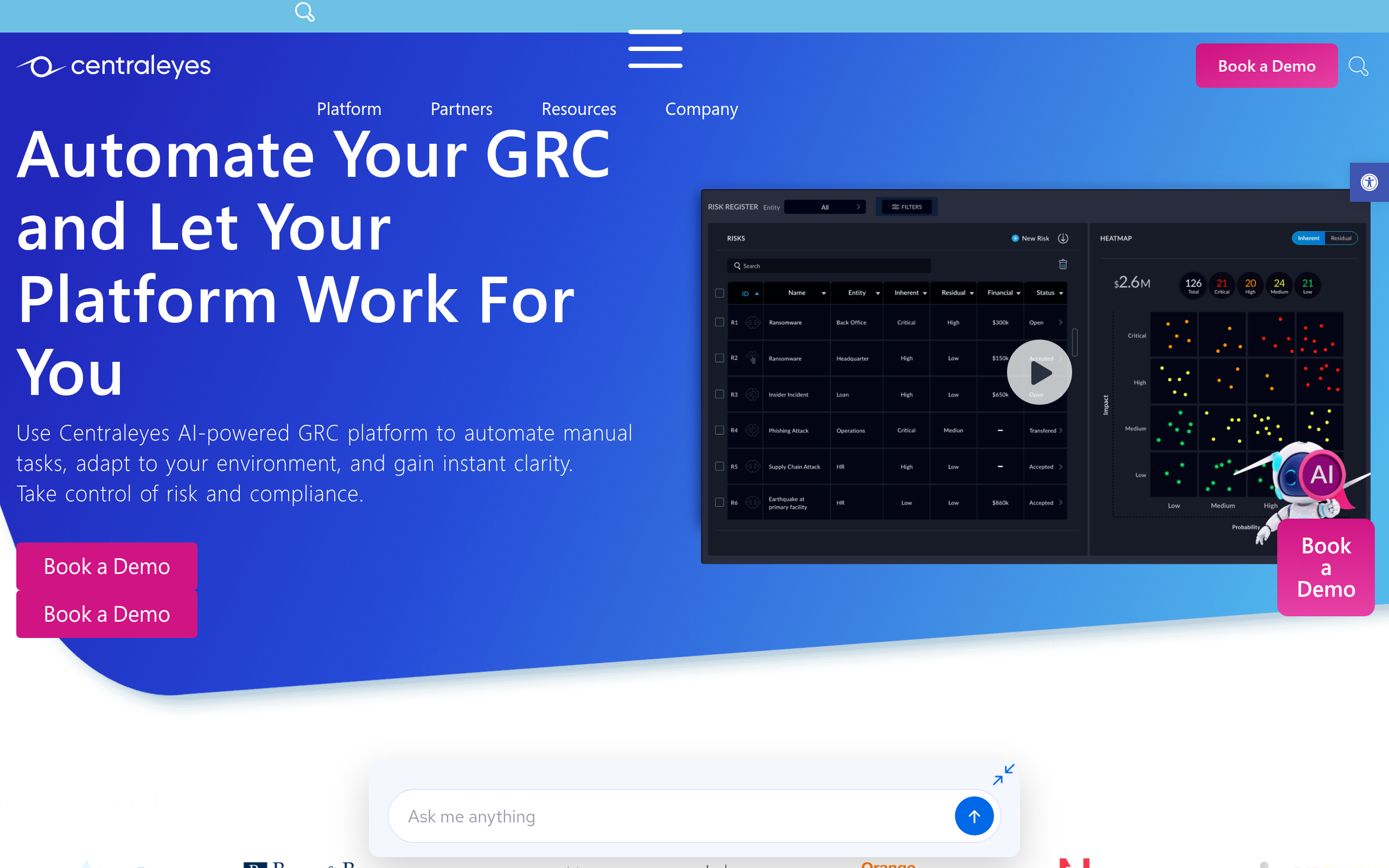
Centraleyes occupies a unique and often overlooked position in the security tool landscape: it is not a scanner, and it does not do detection. Instead, it is a cyber risk management and GRC (Governance, Risk, and Compliance) platform that aggregates findings from your existing scanners, threat intelligence feeds, and compliance assessment workflows into a single quantified risk view.
Where individual tools generate point-in-time scan reports that pile up in analyst inboxes, Centraleyes creates a continuously updated risk posture score that a CISO can present to the board without needing to translate technical findings into business language. It maps vulnerabilities and control gaps to frameworks including NIST CSF, ISO 27001, SOC 2, NIST 800-53, and dozens more — and automates the evidence collection that normally consumes weeks of analyst time before an audit.
The right buyer for Centraleyes is a security leader in a regulated industry — financial services, healthcare, critical infrastructure — who is drowning in scanner output from multiple tools but lacks the connective tissue to prioritize, track, and report on risk holistically. It pairs well with any of the scanning platforms above rather than replacing them.
How Do These Tools Compare Side by Side?
| Tool | Category | Core AI Capability | Deployment | Ideal Buyer |
|---|---|---|---|---|
| Zscaler | Network / Zero Trust | Inline AI traffic classification, C2 and DNS threat detection | Cloud SaaS | Organizations modernizing network security or replacing VPN |
| Centraleyes | Cyber Risk / GRC | Risk aggregation, compliance automation, quantified scoring | Cloud SaaS | CISOs, GRC teams, regulated industries needing board-level reporting |
| CrowdStrike Falcon | EDR / XDR | Behavioral AI, global threat intelligence, threat graph | Cloud + lightweight agent | Large enterprise SOC, MSSPs with deep threat hunting needs |
| SentinelOne Singularity | EDR / XDR | Autonomous response, storyline attack chain reconstruction | Cloud + lightweight agent | Automation-first security teams, lean SOCs reducing analyst toil |
| Microsoft Sentinel | SIEM / SOAR | UEBA, ML anomaly detection, cross-Microsoft-product correlation | Azure SaaS | Enterprises with heavy Microsoft 365 / Azure footprint |
| Tenable.io / Tenable One | Vulnerability Management | Predictive Prioritization, multi-surface exposure scoring | Cloud + agent/scanner | Enterprise vuln management across hybrid, cloud, OT environments |
| Qualys VMDR | Vulnerability Management | TruRisk scoring, AI-assisted patch orchestration | Cloud + agent | All-in-one vuln lifecycle management with compliance reporting |
| Rapid7 InsightVM | Vulnerability Management | Live monitoring, continuous internet asset discovery | Cloud + agent/scanner | Teams prioritizing internet-facing asset visibility and shadow IT |
Which Tool Is Right for Your Team and Budget?
All platforms reviewed here use enterprise, quote-based pricing tied to endpoints, assets, users, or data volume — none publish fixed public prices, and figures change frequently enough that any number in this guide would mislead you. The following scenario mapping is based on widely reported deployment patterns and market positioning rather than specific price points.
| Scenario | Primary Recommendation | Good Pairing | Pricing Model (typical pattern) |
|---|---|---|---|
| Large enterprise with active SOC | CrowdStrike Falcon | Tenable One | Per-endpoint (detection) + per-asset (scanning), annual contract |
| Microsoft-first enterprise | Microsoft Sentinel | Qualys VMDR | Per-GB ingestion + per-asset, consumption-based |
| Zero-trust network modernization | Zscaler | Tenable.io | Per-user SaaS subscription |
| GRC / compliance-driven program | Centraleyes | Any scanner (Tenable / Qualys / Rapid7) | Platform fee, typically per-user or flat tier |
| Automation-first / lean team | SentinelOne Singularity | Rapid7 InsightVM | Per-endpoint + per-asset, annual contract |
| Internet-exposed asset discovery focus | Rapid7 InsightVM | SentinelOne Singularity | Per-asset, with optional add-on modules |
What Is Comparee's Verdict on the Best AI Security Tools for 2026?
Here is the direct answer by buyer profile — no hedging:
- Zero-trust network security: Zscaler is the only platform that proxies and AI-classifies all traffic inline at global scale. If your priority is preventing threats at the network layer across a hybrid workforce, nothing else comes close for that specific problem.
- GRC and risk quantification: Centraleyes is purpose-built for this. It does not replace your scanners — it makes them coherent and boardroom-legible. For regulated industries, it removes the manual toil of compliance evidence collection that has historically consumed security analyst time that should be spent on actual threats.
- Endpoint threat detection with maximum automation: SentinelOne Singularity is the right pick for teams that want autonomous response and minimum analyst intervention. CrowdStrike Falcon is the better call for large enterprise SOC environments that need the deepest threat intelligence and adversary tracking in the industry.
- Cloud-native SIEM on a Microsoft stack: Microsoft Sentinel is the obvious choice. Third-party SIEMs require expensive custom connectors for the same Microsoft data sources Sentinel ingests natively — for Microsoft-centric organizations, that cost difference alone often makes the decision.
- Vulnerability management at enterprise scale: Tenable One is the most complete exposure management platform across hybrid, cloud, and OT environments. Qualys VMDR is a strong alternative if integrated patch orchestration is a priority. Rapid7 InsightVM wins specifically on internet-facing asset discovery and shadow IT visibility.
Most mature programs ultimately run two or three of these tools in combination — a detection layer (EDR/XDR or SIEM), a vulnerability layer (Tenable/Qualys), and a risk aggregation layer (Centraleyes) to make the combined output actionable at the leadership level.
Tools mentioned in this guide
Pricing, features and model availability can change over time. Always verify current details on each tool's official website before deciding.
Frequently Asked Questions
What is the difference between threat detection and vulnerability scanning?
What is the difference between threat detection and vulnerability scanning?
Which AI threat detection tool is best for a lean security team?
Which AI threat detection tool is best for a lean security team?
Is Zscaler a threat detection tool or a vulnerability scanner?
Is Zscaler a threat detection tool or a vulnerability scanner?
What does Centraleyes do and how is it different from a vulnerability scanner?
What does Centraleyes do and how is it different from a vulnerability scanner?
What is XDR and how does it differ from EDR?
What is XDR and how does it differ from EDR?
Can AI security tools replace human security analysts?
Can AI security tools replace human security analysts?
How often should vulnerability scans be run?
How often should vulnerability scans be run?
Is Microsoft Sentinel a good choice for organizations outside the Microsoft ecosystem?
Is Microsoft Sentinel a good choice for organizations outside the Microsoft ecosystem?
Don't just pick a tool — get the whole workflow
Tell Comparee your goal and get a complete step-by-step AI workflow with the right tool for every step.